
Restaurant Technology
Published March 19, 2026
Learn how live order, inventory, and labor metrics reduce food and labor costs, cut wait times, and optimize staffing with centralized dashboards.

Running a restaurant without real-time metrics is like trying to solve problems after they’ve already happened. These tools let you monitor live data from your kitchen, inventory, and staffing so you can act immediately when issues arise. Here’s what you need to know:
Real-time metrics turn reactive management into proactive decision-making. Tools like Bytes AI centralize live data, helping you fix problems as they happen - not after. Keep reading to learn how these tools work and the key metrics to track.
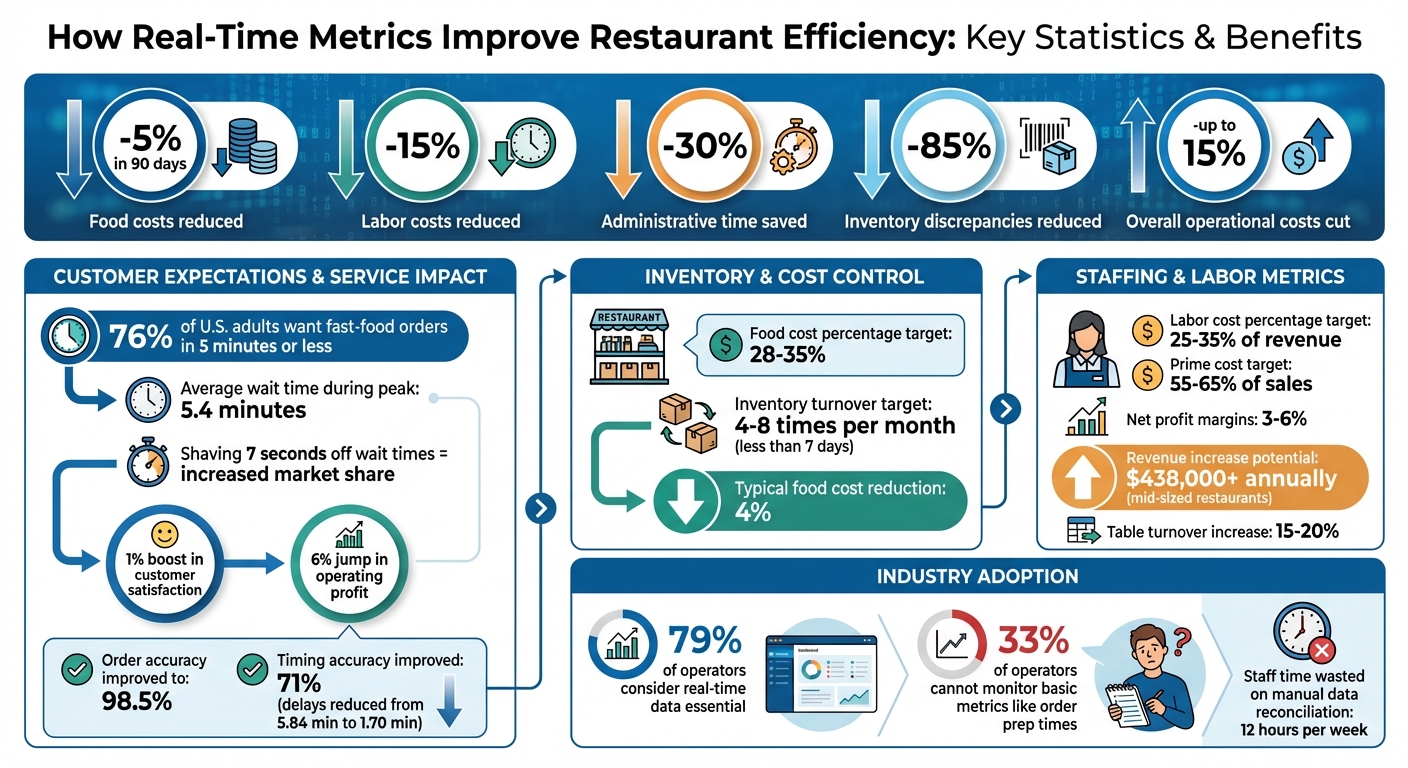
Real-Time Restaurant Metrics: Key Statistics and Benefits
Running a restaurant isn’t just about serving great food - it’s about managing a host of challenges that can make or break your business. Three major hurdles stand out: slow service, poor inventory control, and peak-hour chaos. These issues don’t just inconvenience customers - they eat into profits and tarnish your brand’s reputation. Recognizing these problems is the first step toward using real-time data to make meaningful changes.
When service drags, customers notice - and they don’t forget. Today’s diners expect speed, with 76% of U.S. adults wanting their fast-food orders in five minutes or less. Yet during peak times, the average wait stretches to 5.4 minutes, often pushing customers past their patience limit. The fallout is immediate: abandoned orders, negative reviews, and a hit to your bottom line. Even shaving 7 seconds off wait times can win you more market share.
The problem? Many delays are invisible without real-time tracking. Staff often juggle multiple delivery platforms, manually re-enter phone orders into outdated systems, or struggle to pinpoint which kitchen station is causing a bottleneck. It’s no surprise that one-third of operators can’t monitor basic metrics like order prep times. Yet the stakes are high: boosting customer satisfaction by just 1% can drive a nearly 6% jump in operating profit.
Managing inventory without live data is like flying blind. Many operators still rely on spreadsheets, which only reveal problems after it’s too late. This leads to a costly cycle: overstocking results in spoilage, while understocking forces emergency purchases at retail prices. Both scenarios drain cash flow and hurt profitability.
Consider this: restaurants using inventory software typically see a 4% cut in food costs, and well-implemented systems can slash overall operational costs by 15%. Real-time tracking also helps reduce inventory discrepancies by up to 85%. Beyond the numbers, poor inventory control ties up capital in excess stock or leaves shelves empty, creating unnecessary stress during service.
Rush hours can expose every flaw in your operation. Without real-time insights, managers often overstaff on quiet nights or cut shifts just before a rush, wasting labor dollars either way. Staff are left scrambling between multiple systems, while the kitchen struggles to keep up.
"A single misstep - like a delayed order or a system glitch - can throw off an entire shift. Staff scramble, customers grow impatient, and suddenly, a busy night turns into chaos." - Zoe Ovenden, Author, ChowNow
Disconnected systems also force teams to spend up to 12 hours a week on manual data reconciliation - time that could be better spent on customer service. Add in the congestion caused by third-party drivers waiting for unready orders, and you’ve got a recipe for frustration on all sides.
Understanding these operational pain points highlights the need for real-time metrics to address them effectively.
Real-time data transforms restaurant management from a reactive process to a proactive one. Instead of finding out about issues after a shift ends, managers can identify and resolve problems as they occur. Whether it’s a kitchen delay, a shortage of ingredients, or an unexpected staffing crunch during peak hours, these tools provide the visibility needed to act immediately. As Spindl highlights in its industry analysis, "Real-time analytics shifts the focus from post-mortem analysis to immediate action". This ability to make quick adjustments - like reallocating staff, tweaking workflows, or flagging inventory concerns - can directly address challenges such as slow service, wasted inventory, and staffing bottlenecks before they escalate.
Live order tracking gives managers a moment-by-moment view of kitchen operations, pinpointing exactly where delays occur. For instance, if a ticket lingers at the grill station for eight minutes, a dashboard alert can prompt an immediate shift in staffing to keep things moving. Restaurants using these systems have seen a 71% improvement in timing accuracy, slashing average delays from 5.84 minutes to just 1.70 minutes. This precision ensures orders hit the "Goldilocks Zone", where food is ready exactly when the customer or courier arrives - not too early and not too late.
"This zone represents the sweet spot for food readiness: not too early, not too late, but just right." - Curbit Team
Integrated dashboards also solve the "tablet farm" problem by consolidating data from multiple sources. This setup boosts order accuracy to 98.5% and helps restaurants consistently meet delivery timelines, improving third-party ratings. Configuring dashboards to send alerts when ticket times exceed 10 minutes or queue lengths grow too long - and refreshing data every 30 to 60 seconds - keeps managers in sync with kitchen activity.
Live inventory tracking eliminates guesswork by providing instant updates on stock levels, usage patterns, and expiration dates. With POS systems that automatically deduct ingredients as orders come in, managers always know what’s available. This real-time insight prevents the dual disasters of running out mid-service or over-ordering items that spoil before use.
Restaurants using these systems typically reduce food costs by 4% and can cut overall operational expenses by up to 15%. Inventory discrepancies drop by as much as 85%. Real-time tools also enforce the First-In, First-Out (FIFO) method, prioritizing older stock to minimize waste. Automated low-stock alerts prevent costly last-minute purchases, and comparing actual usage to theoretical yield can uncover inefficiencies like over-portioning or theft.
"A good inventory management system should provide detailed reporting on cost of goods sold, waste tracking, and usage trends over time." - Lauren Noreen, Senior Product Marketing Manager at Marketman
For high-value items like proteins, setting threshold alerts and conducting daily monitoring, along with weekly stock counts, refines inventory control. Regularly updating par levels every two weeks to reflect seasonal demand and integrating inventory platforms with POS and accounting software further reduces errors.
Just as real-time inventory data streamlines stock control, live sales data sharpens staffing strategies.
Real-time sales data helps managers respond to demand surges as they happen, rather than relying on end-of-day reports. Hourly sales heat maps and order volume metrics reveal when rushes occur, allowing for immediate staffing adjustments - like moving a server to packaging or assigning a line cook to clear a backlog.
Beyond managing surges, this data also highlights overstaffing. Metrics like Sales per Labor Hour and Covers per Labor Hour show whether your team is generating enough revenue or if adjustments are needed to protect margins. For example, a $2 improvement in Revenue per Available Seat Hour (RevPASH) can translate to more than $438,000 in additional annual revenue for mid-sized restaurants.
Cross-training staff for multiple roles ensures flexibility when live data signals a bottleneck. Comparing current sales to "same day last week" benchmarks helps identify whether a surge is predictable or an outlier. Meanwhile, digital kitchen display systems track order-to-table times to locate slowdowns. AI-driven scheduling based on historical sales trends can also trim labor costs by 15%, a critical advantage when many operators struggle to monitor even basic metrics like average order times.
Bytes AI takes the concept of real-time metrics and pushes it further by offering advanced integration tools. Instead of juggling multiple systems, managers gain a single, centralized view of their operations. The platform's AI-powered phone assistants streamline tasks like order-taking and bookings, while its centralized order aggregation compiles data from services like DoorDash and UberEats into one dashboard. This eliminates the guesswork that often slows decision-making during hectic shifts.
Bytes AI's dashboards are equipped with modular widgets that continuously update, providing live insights like sales heat maps, table turnover rates, and critical kitchen metrics. For instance, if a table remains occupied for 45 minutes during a busy dinner rush - surpassing the target - an alert notifies staff to speed up service, which could increase seating capacity by 15–20%. Similarly, when a kitchen backlog starts building, managers can quickly reassign staff to clear the queue before delays escalate.
Real-time alerts allow for immediate adjustments, and Bytes AI centralizes these capabilities for even greater efficiency. The platform monitors labor percentages in real time, so when staffing costs exceed set thresholds, managers can make quick changes. For operators managing multiple locations, the system enables simultaneous performance tracking, benchmarking across units, and ensuring consistency without waiting for end-of-day reports.
Bytes AI is also expanding its capabilities with new features designed to automate critical decisions. The upcoming Bytes POS system will integrate real-time sales tracking directly with inventory and labor dashboards. By syncing live sales data with stock levels, the system will issue alerts for overproduction or waste. For example, if a slow-selling appetizer starts piling up in the kitchen, the POS flags it immediately, allowing managers to adjust preparation or launch a targeted promotion. The POS will also support multi-payment processing and customer loyalty programs, linking transactional data to operational metrics for better control.
Additionally, new AI assistants will handle tasks like reservation bookings and menu inquiries over the phone, easing the burden during peak hours. These assistants will also provide proactive solutions, such as alerting managers to bring in extra staff when live data signals an unexpected rush. By reducing manual errors in order-taking and automating routine tasks, these tools extend the benefits of real-time data from monitoring to immediate action. Together, these features empower restaurants to address operational challenges as they arise, turning insights into actionable solutions in the moment.
Tracking the right numbers can make or break a restaurant. These metrics help pinpoint slow service, inventory challenges, and staffing issues. While having real-time dashboards is great, knowing what to monitor is even more important. These key indicators not only measure how well your restaurant is doing but also allow you to make quick adjustments when needed. The best operators focus on metrics that directly improve customer experience and profitability. Here’s a closer look at the numbers that keep restaurants running smoothly.
Table turnover measures how often tables are used during a shift and directly affects revenue. Quick-service restaurants generally aim for 3–6 turns per hour, casual dining averages 2–3, and fine dining typically sees 1–2 turns. Across many dining concepts, a good benchmark is around 1.5–2 turns per meal period.
If turnover is slow, it could point to issues like delays in the kitchen, slow payment processing, or inefficient table cleaning. By monitoring this metric in real time, managers can quickly identify bottlenecks and reassign staff to speed up table turnover, ultimately increasing the number of guests served.
Food cost percentage shows how much of your sales revenue goes toward ingredients. Industry standards suggest keeping this figure between 28% and 35%. If costs exceed this range, it could signal problems like inconsistent portion sizes, rising supplier prices, waste, or even theft.
"Rising food costs driven by inflation are squeezing restaurants from every angle. Ingredients fluctuate weekly and menu prices can't always keep up." - Eric Jeffay, Senior Product Manager at MarginEdge.
Inventory turnover tracks how quickly your kitchen uses up its stock. Restaurants focusing on fresh ingredients should aim to turn over inventory in less than seven days, or about 4–8 times per month. Low turnover can tie up cash and lead to spoilage, while high turnover reflects efficient ordering and freshness. For instance, in November 2025, Burger 21 used MarginEdge to lower food costs by 2% and streamline inventory management, proving the value of real-time tracking.
Labor cost percentage measures how much of your revenue goes toward wages, benefits, and payroll taxes. Ideally, labor costs should fall between 25% and 35% of revenue, though casual dining models may aim for 30–40%. Balancing staffing levels with guest traffic is critical - overstaffing eats into profits, while understaffing hurts service quality.
Real-time tracking allows managers to adjust schedules based on projected sales rather than sticking to outdated routines. Additionally, keeping the prime cost - the combined total of food and labor costs - between 55% and 65% of sales is essential. With restaurant net profit margins typically ranging from just 3% to 6%, controlling prime costs is crucial for staying profitable over time.
Restaurants thrive on efficiency, and real-time metrics are the key to tackling challenges like slow service, inventory waste, and peak-hour chaos before they spiral out of control. Instead of waiting until the end of a shift to uncover issues, managers can spot station slowdowns in just 15 minutes and address them on the spot. The result? Faster table turnover, reduced food waste, and staff schedules that align perfectly with customer demand.
The numbers speak for themselves: restaurants leveraging integrated tech stacks have seen food costs drop by 5% within 90 days, labor costs cut by 15% thanks to AI-driven scheduling, and administrative tasks streamlined - saving 30% of time by consolidating data into a single dashboard. With 79% of operators considering real-time data essential to their success, this isn't just a nice-to-have; it's a requirement to stay competitive.
"Real-time analytics shifts the focus from post-mortem analysis to immediate action." - Spindl
Bytes AI takes these benefits a step further, turning real-time data into practical solutions. Bytes AI provides centralized dashboards that pull together delivery channels, in-house sales, and inventory, offering a unified view that eliminates the headache of managing multiple systems. Plus, with the upcoming Bytes POS and AI-powered assistants, restaurants gain even more control during those high-pressure peak hours.
Focusing on real-time metrics is crucial for running a smooth operation. Keep a close eye on numbers like sales and revenue, inventory levels, labor costs, and order preparation times. These metrics can reveal problems early - like slow service, stock running low, or labor costs spiraling out of control. By staying on top of these, you can address issues quickly and keep things running efficiently.
To keep tabs on ticket times and inventory levels, start by configuring your monitoring tools to track critical metrics, such as maximum ticket times or minimum stock levels. Set clear thresholds for these metrics and enable alerts to notify you whenever these limits are breached. By staying ahead of potential issues, you can tackle slow service or low inventory before they disrupt your operations.
To make real-time dashboards work in a restaurant, different systems need to work together smoothly. The POS system plays a central role, providing live updates on sales, orders, and revenue. Meanwhile, inventory systems keep track of stock levels as they change. Online ordering platforms and kitchen display systems (KDS) help monitor the flow of orders seamlessly. Adding labor scheduling and customer activity data gives even more insight, helping to identify peak hours, manage staffing needs, and improve overall efficiency.