
Restaurant Technology
Published March 8, 2026
AI turns scattered restaurant reviews into real-time insights and alerts, letting teams fix issues faster and boost guest satisfaction.

AI is transforming how restaurants handle customer feedback by automating the collection, analysis, and response process. Here's why it matters:
AI consolidates feedback from various sources, categorizes it by themes like food quality or service speed, and provides actionable insights. By integrating AI tools with systems like POS platforms, restaurants can link feedback to transactions, detect trends, and make data-driven improvements. This approach saves time, enhances service, and protects online reputations.
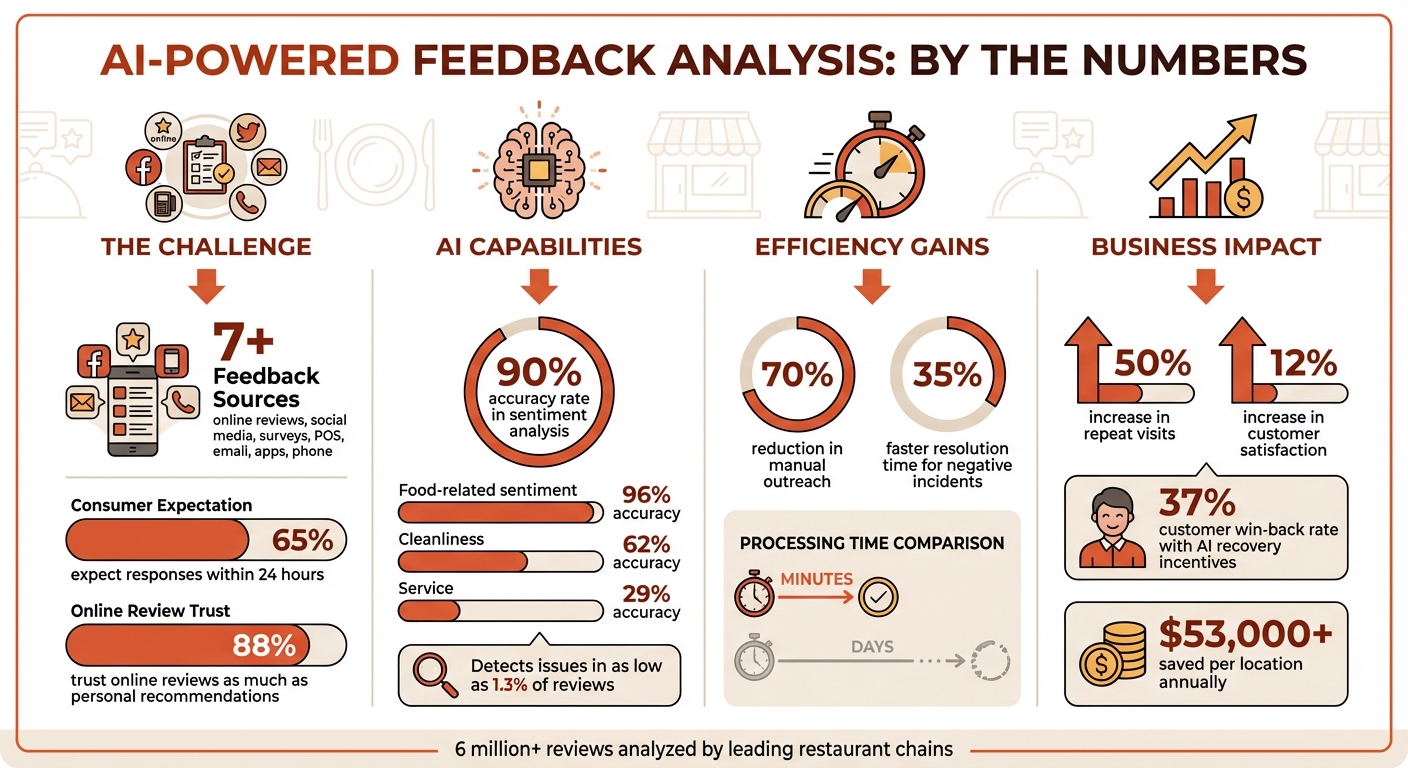
AI Restaurant Feedback Analysis: Key Statistics and Impact Metrics
AI takes the heavy lifting out of feedback collection, analysis, and response. Instead of manually sifting through endless reviews across multiple platforms, AI systems use Natural Language Processing (NLP) to clean, categorize, and assign sentiment scores to customer comments. These systems boast an impressive 90% accuracy rate in sentiment analysis, making it easier for restaurants to quickly identify whether feedback is positive, neutral, or negative. This level of precision allows for faster responses to issues and helps improve the overall dining experience.
But what makes AI truly stand out is its ability to detect patterns that might go unnoticed by human teams. Using machine learning, AI can process vast amounts of data to pinpoint recurring issues - whether it's frequent complaints about slow service at a specific location or a rare recipe problem that shows up in just 1.3% of reviews. Jared Castronova, Head of Marketing Communications at Checkmate, puts it succinctly:
AI-enabled feedback analysis simplifies this process by quickly sorting through large volumes of data to identify trends and insights.
This is especially useful when restaurants are juggling feedback from at least seven different sources, including online reviews, social media, surveys, POS systems, emails, mobile apps, and phone transcripts.
AI also transforms feedback from a reactive process into a proactive tool. By setting up sentiment thresholds, restaurants can get instant alerts via Slack or email when critical keywords like "sick" or "cold food" appear in customer comments. This real-time monitoring allows managers to address problems during the same shift rather than discovering them days later. For example, automated feedback systems have been shown to reduce resolution time for negative incidents by 35% while increasing customer satisfaction by 12%. This approach turns raw feedback into actionable insights that drive meaningful improvements.
AI platforms streamline the feedback collection process by syncing data from multiple sources into one central dashboard. APIs connect directly with tools like POS systems (e.g., Toast), hospitality management platforms (like Mews), social media channels, and review sites. Once the feedback is gathered, NLP pipelines clean, segment, and analyze each comment for sentiment. What might take a human team days to process can be done in minutes, with alerts triggered as soon as an issue is flagged.
AI goes beyond surface-level sentiment analysis by diving into specific topics like "delivery delays" or "menu pricing". For instance, if several comments mention undercooked chicken, the system can categorize these under "food quality" and "food safety", immediately notifying the kitchen team. Automated workflows further enhance efficiency: when a customer leaves a low sentiment score, the system might trigger a follow-up survey to gather more context or send an apology email with a discount code. These workflows can reduce manual outreach by up to 70%, freeing up staff for other tasks.
Once feedback is structured, AI digs deeper, identifying sentiment trends and recurring issues that might otherwise go unnoticed.
AI doesn't just label feedback as positive or negative - it helps uncover the "why" behind customer sentiment. By using techniques like topic modeling and text classification, AI clusters related comments to reveal recurring themes such as "food temperature", "service speed", or "cleanliness". For example, if 15 customers mention "long wait times" over two weeks, AI flags this as a trend that needs attention.
Different methods power this analysis. Lexicon-based approaches match words against sentiment dictionaries for quick evaluations, while machine learning models adapt to a restaurant's unique language over time. Deep learning models, although more resource-intensive, can even detect subtleties like sarcasm. Many systems combine these methods to balance speed and accuracy.
AI also goes a step further by analyzing emotional intensity. For example, a comment like "The pizza was amazing, but the wait was too long" contains both positive and negative elements. AI separates these aspects, ensuring that positive highlights are acknowledged even as issues are addressed. This nuanced understanding can be a game-changer for customer retention. Real-world examples show that AI systems identifying at-risk customers and offering recovery incentives can win back up to 37% of those who might otherwise stop visiting.
Speed matters when it comes to addressing serious complaints. AI systems monitor reviews across platforms like Google, Yelp, Facebook, and TripAdvisor, scanning for negative sentiment and recurring problems. When critical keywords or patterns emerge, managers receive instant alerts. This allows them to intervene during the same shift, showcasing how real-time data processing can lead to quicker resolutions and continuous improvements.
But the benefits go beyond crisis management. AI also tracks sentiment trends over time, helping managers evaluate the effectiveness of their interventions. For instance, if a recipe adjustment is made based on feedback, the system can monitor whether complaints decrease. This creates a feedback loop where customer insights drive ongoing improvements.
AI's integration with on-site systems makes it even more powerful. Connected to POS systems, QR codes, or SMS platforms, AI can capture and act on feedback instantly. Imagine a guest scanning a QR code to report cold food - within seconds, the floor manager gets an alert, allowing them to address the issue before it escalates. This not only prevents negative online reviews but also protects the restaurant's reputation, which is critical since 88% of consumers trust online reviews as much as personal recommendations.
To ensure privacy and compliance with regulations like GDPR, AI platforms anonymize personal data and use encrypted channels for data transfer. This ensures that customer feedback is handled securely while still delivering actionable insights.
Before diving into AI feedback tools, take stock of your current feedback methods and identify any gaps. This step ensures that even the most advanced AI system provides insights you can act on.
Start by laying out all the ways you currently collect feedback. This could include in-store QR codes on tables or receipts, paper comment cards, Wi-Fi login pages, website widgets, and third-party review platforms like Google, Yelp, or TripAdvisor. If feedback is scattered across multiple channels, it can make it harder to get a clear picture of your guests' experiences.
Timing matters too. Modern systems focus on gathering feedback at key "moments of truth" - like right after payment or checkout - when the experience is still fresh in the guest's mind. Delayed feedback requests often result in vague or forgotten details. Also, check if your Point of Sale (POS) or Property Management System (PMS) can automate feedback requests. This kind of integration makes the process smoother and more efficient.
To measure how AI tools are performing, set clear, measurable goals. Look at metrics like guest satisfaction scores, average star ratings, Net Promoter Scores (NPS), and how often complaints arise. Before implementing any AI system, record your current numbers - such as your average online rating or how quickly you respond to negative feedback. These benchmarks will help you track improvements.
For example, online reviews play a major role in influencing diner decisions. Knowing your starting point lets you see how far you've come. Set specific targets, like cutting response times or gradually raising your average ratings. You can even track financial outcomes by monitoring how often guests redeem automated recovery offers, like a 10% discount sent after a critical review.
AI systems rely on clean, consistent data to work effectively. Standardize formats for dates (MM/DD/YYYY), locations, and menu item names to avoid confusion. Use multiple-choice questions in surveys to gather data that’s easy for AI to compare and analyze for trends. At the same time, open-ended responses provide the context needed for accurate sentiment analysis.
Organize feedback into clear categories - like Food Quality, Service, Ambiance, and Menu Selection - so the AI can break down performance by area and even link feedback to specific transactions or menu items. This helps pinpoint recurring issues more precisely. Lastly, ensure your data is stored securely. Use encrypted channels for data transfer and anonymize personal details to protect guest privacy while still gaining actionable insights.
With a mapped-out feedback process, measurable goals, and standardized data, you're set to integrate AI feedback tools into your restaurant operations seamlessly.
Once your feedback processes are mapped out and your goals are defined, the next step is integrating AI tools to quickly extract insights you can act on.
When choosing an AI feedback tool, prioritize these four essential capabilities:
Some advanced tools also include AI-powered review responses that align with your brand's tone and operational heat maps that highlight which locations or shifts generate more negative feedback. These features can guide targeted improvements in training and processes.
Once you've selected the right AI tools, the next step is integrating them with your existing systems for a seamless feedback workflow.
AI feedback tools are most effective when they work in harmony with your current technology. For example, linking the AI platform to your POS system provides detailed context by associating feedback with specific transactions, menu items, or servers. If a particular dish generates frequent complaints, you’ll see this trend alongside its sales data.
Connecting delivery platforms can also centralize reviews and order feedback. Tools like Bytes AI’s centralized order aggregation pull data from major online ordering platforms into a single dashboard, eliminating the fragmentation caused by siloed data.
Additionally, integrating your phone system can capture voice feedback. Bytes AI’s AI-powered phone assistants record feedback during calls, manage orders and bookings, and log interactions for further analysis. This feature adds a layer of personalization by tracking customer occasions for tailored follow-ups. The service costs $279.99 per month.
When setting up these integrations, ensure API compatibility, secure access credentials, and test data flow thoroughly. Real-time syncing of menus and pricing is also crucial to avoid inventory mismatches.
Once your systems are integrated, you’re ready to operationalize your AI-driven feedback process.
Follow a structured approach to set up your AI feedback workflow:
AI feedback analysis is only as useful as the actions you take. Focus on addressing the most pressing issues identified by the AI, assign responsibility to specific team members, and test potential solutions before rolling them out more broadly.
For example, if AI highlights frequent complaints about long wait times during the weekend lunch rush, you could adjust staffing by adding more servers during peak hours. This kind of data-driven adjustment has been shown to reduce complaints by 20–30%. Similarly, if sentiment analysis shows a growing interest in plant-based menu options, introducing vegan dishes could both boost sales and improve satisfaction scores.
To measure the success of these changes, compare feedback before and after implementation. Suppose you retrain staff to address negative service reviews - track sentiment in the "Staff Friendliness" category over the next few weeks to see if scores improve. AI tools that provide ongoing summaries and sentiment tracking make it easier to assess whether your adjustments are working. Once changes are made, keep monitoring and refining your approach to ensure long-term success.
AI models need regular attention to stay accurate. Use your dashboard to monitor sentiment trends and the accuracy of theme categorization on a weekly basis. Real-time alerts for emerging issues can help you address problems before they escalate.
As your business evolves, update your AI to reflect new priorities. If delivery speed becomes a frequent concern, add it as a dedicated category. Refresh keywords every quarter and retrain the model with new data to maintain precision. Over time, AI learns patterns through machine learning, but it still requires consistent updates. Currently, existing models focus 96% on food quality, 62% on cleanliness, and 29% on service.
Human oversight is also crucial for improving AI accuracy. For instance, if the system incorrectly flags "the wait was worth it" as a negative comment due to the word "wait", manually correct the error and retrain the model. Regularly reviewing results and updating keywords - especially after significant changes like a new menu rollout - ensures feedback is categorized correctly. Continuous monitoring keeps the feedback loop effective and helps streamline operations.
To take these improvement strategies even further, Bytes AI provides tools designed to enhance feedback analysis. Their custom-branded websites and apps ($259.99/month) and AI-powered phone assistants ($279.99/month) incorporate feedback forms and voice surveys, making it easier to collect and act on customer input.
This system links feedback directly to transactions, helping you identify trends in menu performance or specific location issues. For example, the AI-powered phone assistants can capture customer opinions during calls for orders or reservations, using natural language processing to analyze comments about service or food quality. This unstructured feedback is then fed into your analytics, enabling you to detect recurring themes and make timely adjustments, such as retraining staff, before small issues grow into larger problems.
AI has transformed the way businesses handle customer feedback. What used to take weeks through manual review can now be completed in mere minutes. For instance, one restaurant chain analyzed over 6 million customer reviews across multiple brands, showcasing the speed and efficiency of AI. This rapid turnaround allows restaurants to address pressing issues, such as weekend staffing shortages, before they spiral into larger problems.
The financial benefits are just as compelling. AI-driven systems can save restaurants over $53,000 per location annually by automating responses, preventing costly menu mistakes, and simplifying feedback workflows. By categorizing customer sentiment in key operational areas, AI shifts the focus to what matters most. This data-driven approach replaces reactive decisions with strategic planning, improving both customer satisfaction and operational efficiency.
Integration is made even easier with platforms like Bytes AI. Their tools, such as custom-branded websites and apps ($259.99/month) and AI-powered phone assistants ($279.99/month), seamlessly collect feedback during orders and reservations. By linking this feedback with transaction data, businesses can uncover trends in menu performance and service quality across locations.
To maximize these benefits, ongoing monitoring and updates are essential. Treat AI as a tool for continuous improvement - regular oversight, quarterly keyword updates, and fine-tuning will keep it aligned with your evolving business needs. With the right strategy, AI feedback analysis not only saves time but also provides a competitive edge through faster insights, better guest experiences, and smarter decisions.
To begin, take a close look at how you currently handle feedback. Pinpoint challenges - whether it’s juggling a high volume of reviews or staying on top of social media comments. Once you know where the gaps are, focus on tools that can gather feedback from various platforms, highlight recurring themes, and turn that data into practical steps you can take.
Key features to prioritize include sentiment analysis, which helps gauge customer emotions, trend detection to spot patterns over time, and automation to streamline repetitive tasks. Also, make sure the tool you choose integrates seamlessly with your existing systems and aligns with your broader goals for improving customer satisfaction and protecting your reputation.
AI feedback software should first connect with systems that handle customer feedback channels - think review sites, social media platforms, and surveys - and order management tools like POS systems. By doing this, the AI can evaluate sentiment and spot trends, while also tying customer feedback about orders and service directly to operational performance. This approach makes it easier for restaurants to pinpoint areas that need improvement.
To keep notifications in check, implement a feedback loop that adjusts thresholds using historical data and past alert outcomes. This approach strikes a balance between sensitivity and reducing unnecessary alerts.
Another effective tactic is allowing analysts to tag alerts as either true or false positives. Over time, this refines the thresholds, ensuring notifications stay relevant. Together, these strategies help manage thresholds dynamically, cutting down on alert fatigue while still keeping systems responsive.