
Restaurant Technology
Published March 4, 2026
How restaurants fix fragmented orders, inventory mismatches, ETA errors, data silos, and franchise integration with centralized, real-time tools.

Struggling with delivery data chaos? Here’s how to fix it.
Managing orders across multiple platforms like DoorDash and Uber Eats can feel overwhelming. Without proper integration, restaurants face issues like manual data entry errors, inconsistent inventory, and frustrated customers due to late deliveries or unavailable items. These problems affect efficiency, customer satisfaction, and profits.
Here’s a quick breakdown of the top problems and their solutions:
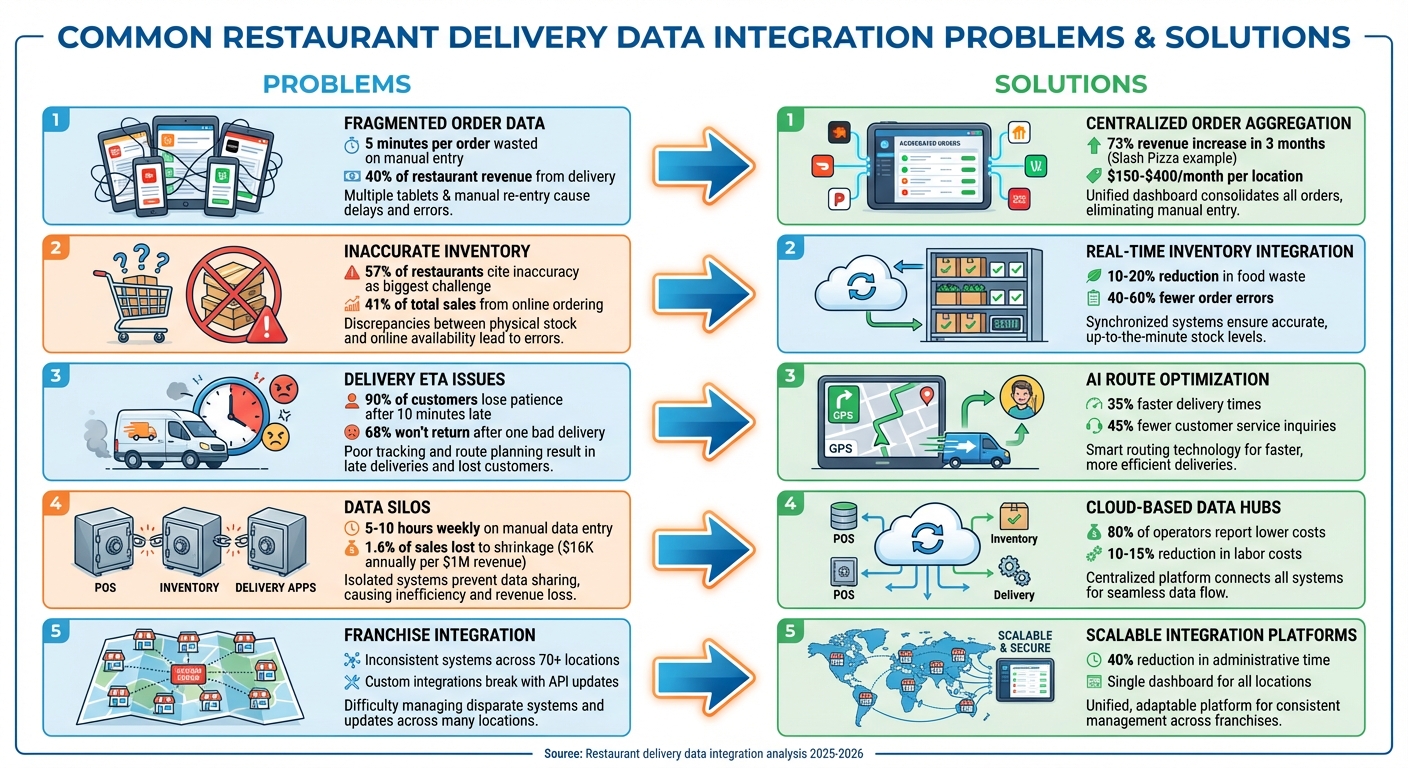
5 Common Delivery Data Integration Problems and Solutions for Restaurants
Managing orders from platforms like DoorDash, Uber Eats, Grubhub, and direct phone calls can feel like juggling too many balls at once. Each channel operates independently, forcing staff to handle multiple tablets during peak times. To make matters worse, employees often have to manually re-enter every order into the POS system - a task that eats up about five minutes per order and opens the door to mistakes like missed modifiers or incorrect items.
The inconsistencies don’t stop there. For example, one platform might record an address as "5th Street", while another spells it out as "Fifth Street". These small differences create big headaches for sales reconciliation, requiring hours of manual cleanup. As Luke Andrews, SVP of Product at Nextbite, aptly put it:
"It's messy and unscalable to manage manually".
On top of that, accounting teams often face an uphill battle trying to match third-party reports with actual sales data. And during busy hours, staff must manually update out-of-stock items across multiple apps, risking customer frustration from unavailable orders, refunds, and negative reviews. Considering that delivery now accounts for nearly 40% of total restaurant revenue, these inefficiencies are more than just a hassle - they’re a direct hit to profits.
The answer to these challenges lies in centralized order aggregation. By consolidating orders from all delivery platforms into a single system - or directly integrating them into the POS - restaurants can streamline their operations and minimize human error. This automation not only saves time but also reduces mistakes. Take Slash Pizza in Glendale, CA, for example: after adopting the Orders.co integration system in 2025, they managed to increase their total online revenue by 73% in just three months.
One standout benefit of centralized aggregation is real-time menu synchronization. Any updates to pricing or availability are instantly reflected across all connected platforms. This eliminates the risk of customers ordering items that are sold out. Pops Artisanal Creamery in Los Angeles used this feature across three locations, cutting down refund requests and improving customer satisfaction. Tools like Bytes AI make this process seamless by connecting directly with major delivery platforms, allowing restaurants to manage all orders through a unified dashboard.
While these platforms typically cost $150–$400 per month per location, with setup fees ranging from $500 to $4,000, the benefits quickly outweigh the costs. Restaurants save on labor, reduce errors, speed up order processing, and even improve their rankings on delivery apps. On top of that, centralized systems provide unified analytics, making it easier to identify top-performing items - no spreadsheets required.
When inventory data isn’t properly synchronized, the results can be frustrating for both businesses and customers. Overselling and underselling become common issues, often caused by manual data entry errors. For instance, re-entering information into the POS system can introduce typos in quantities or prices, leading to significant discrepancies over time. The problem worsens when businesses use multiple platforms without a unified system to keep everything in sync.
The statistics highlight just how widespread this issue is. A staggering 57% of restaurants cite inaccuracy or inefficiency as their biggest challenge with manual order entry. Missing invoices can delay or even prevent inventory updates, leaving stock levels outdated. Additionally, when ingredients are moved between locations without proper logging, it creates "phantom" shrinkage - one location appears to have stock that’s already been transferred elsewhere. As Elizabeth Stacks from Crunchtime explains:
"When the invoice is missing, you risk: Delays or blocks to posting inventory, errors in financial reporting... and confusion when transferring goods between locations".
The consequences extend beyond operational headaches. Imagine ordering your favorite dish online, only to be told it’s unavailable after you’ve already paid. This kind of experience damages customer trust and disrupts operations, especially as online ordering now accounts for 41% of total restaurant sales. These mismatches make it clear why automated inventory management is no longer optional - it’s essential.
The good news? Advanced POS systems can eliminate these headaches by automating inventory updates across platforms in real time. For instance, these systems track ingredient usage at the ingredient level, updating stock levels instantly when an order is placed. If someone orders a pizza, the system automatically deducts the dough, cheese, and toppings from inventory, ensuring the numbers are always accurate. This prevents situations where an item appears available on the menu but can’t actually be prepared due to missing ingredients.
The benefits of real-time integration are hard to ignore. Restaurants using unified API systems report a 10–20% reduction in food waste thanks to improved inventory tracking. Automated delivery flows have also been shown to cut order errors by 40–60%. Additionally, these systems can "86" items across all digital menus simultaneously through a single dashboard, saving time and avoiding customer frustration.
Low-stock alerts are another game-changer. Managers receive instant notifications when inventory levels fall below set thresholds, allowing them to restock or adjust menus proactively. Tools like Bytes AI integrate seamlessly with major delivery platforms, ensuring online menus always reflect what’s actually available in the kitchen. Pricing for these systems typically ranges from $199 to $249 per month, depending on the plan.
Late deliveries and unpredictable arrival times are a recipe for unhappy customers. In fact, 90% of customers lose patience if an order is just 10 minutes late. Even worse, 68% of shoppers won't return after a single negative delivery experience. That’s not just a missed delivery - it’s a customer you may never win back. Like inventory and order management, accurate ETAs are a cornerstone of smooth delivery operations.
But the problem isn’t just about traffic. Standard mapping APIs often fall short because they focus only on drive times. They don’t account for delays like finding parking, navigating tricky building layouts, or other real-world obstacles. On top of that, inaccurate geocoding can drop a driver several blocks away from the actual destination, leaving them circling aimlessly. Another common issue? Many systems overlook kitchen preparation time, failing to factor in how long it takes to get the order ready before the driver can even leave.
These inaccuracies come at a cost. 50% of customer service calls and 30% of live chat inquiries stem from ETA issues, pulling staff away from more critical tasks. Late deliveries often lead to refund requests or discounts offered as apologies, directly cutting into profits. As HyperTrack puts it:
"It is your job to predict those extra 10 minutes in the computed ETA to set the right expectation and make the delivery on time".
Fixing these issues requires smarter tools - ones that go beyond static maps and embrace dynamic, real-time adjustments.
The answer lies in combining live mapping data with AI-driven route optimization. Unlike static estimates, modern systems use real-time traffic updates, road closures, and weather conditions to adjust ETAs on the fly. Machine learning takes it a step further, analyzing delivery sequences to find the most efficient routes based on distance, capacity, and time constraints. The result? AI-powered route optimization can cut delivery times by up to 35%.
The benefits are clear in real-world applications. For example, in 2026, Chef Nicole Miami switched from manual Excel planning to Upper Route Planner. This change saved 10 hours of work weekly, allowed the business to handle 62% more orders, and boosted productivity by 46%. UPS’s proprietary ORION platform optimizes routes using GPS, saving the company over 100 million miles and 10 million gallons of fuel annually. Swiggy, a major player in India’s delivery scene, reduced average delays by 20% by incorporating real-time driver locations, traffic data, and restaurant readiness into their system.
Integration is crucial. Tools like Bytes AI connect with major delivery platforms to provide live tracking updates for customers while rerouting drivers automatically when delays arise. Setting up delivery zones with built-in time buffers for farther locations ensures realistic expectations from the start. Visual dispatch systems that flag late orders help kitchen staff prioritize tasks and update ETAs in real time. These real-time tracking platforms can cut customer service inquiries by up to 45%, freeing up your team to focus on delivering great service where it counts most - getting orders to customers on time and intact.
Even with centralized order aggregation and real-time inventory tools in place, fragmented data can still create silos that bog down operations. Imagine this: your delivery data is scattered across multiple platforms - DoorDash, Uber Eats, Grubhub - each living in its own app. The result? Your staff spends 5–10 hours every week manually inputting orders into the POS. That’s valuable time that could be focused on serving guests, not wrestling with tech. These inefficiencies make scaling nearly impossible.
Fragmented systems also leave leadership in the dark. Without a clear view of platform performance or revenue metrics, decision-making becomes a guessing game. Reporting mismatches can obscure critical costs, like third-party commissions or inventory shrinkage. Speaking of shrinkage, issues like spoilage and miscounts can drain 1.6% of sales, which adds up to over $16,000 annually for a restaurant with $1 million in revenue.
And let’s not forget the customer experience. Siloed data causes inaccurate wait times, missed order modifications, and orders for items that are already out of stock - all because inventory isn’t synced in real time. The stats paint a clear picture: equipment downtime in quick-service restaurants (QSRs) - often linked to fragmented systems - can eat up 11% of annual revenue. Plus, 24.4% of third-party orders arrive late, incomplete, or incorrect, largely due to disconnected systems failing to communicate. These inefficiencies underscore the need for a unified, cloud-based solution.
The answer lies in centralizing your operations through a cloud-based data hub. This type of system consolidates orders, inventory, and reporting into a single, easy-to-use dashboard. Instead of managing multiple tablets, your team can handle everything from one interface that syncs directly with your POS. Take Slash Pizza in Glendale, CA, as an example. In 2025, they integrated DoorDash, Uber Eats, and Grubhub orders into a centralized platform. By syncing menu updates and using unified reporting to track their best-selling items, they boosted their total online revenue by 73% in just three months.
Cloud-based hubs also eliminate the headaches of manual data entry and the need to clean up messy reporting formats. For instance, one app might list "5th Street", while another uses "Fifth Street" - a centralized system resolves these inconsistencies automatically. Additionally, these hubs offer real-time inventory syncing, ensuring that sold-out items are instantly updated across all delivery platforms. This reduces refunds and improves customer satisfaction.
The benefits are hard to ignore. 80% of restaurant operators report lower costs after adopting digital tools and system integrations. With AI-powered analytics baked into these platforms, staffing can be optimized, cutting labor costs by 10–15%. Solutions like Bytes AI provide centralized order management and seamless integration with major platforms, offering a comprehensive view of your delivery operations. By breaking down data silos, these tools not only streamline workflows but also give leadership the insights they need to turn delivery data into a competitive advantage. As Vishal Agarwal, CEO of ItsaCheckmate, aptly puts it:
"They do not know how the sausage got made, but the final product is the bacon that they love".
Operating a franchise network comes with its own set of hurdles, especially when it comes to integration. Unlike single-location restaurants, franchises often deal with fragmented POS systems and a mix of accounting tools across their various locations. This lack of uniformity can disrupt the customer experience, making it inconsistent from one location to another.
Without centralized control, franchises face issues like inconsistent menu pricing or outdated menu items. Take, for example, a national restaurant group that, in August 2025, faced this exact problem. With over 70 locations spanning three brands, their fragmented tech systems created data silos, making it nearly impossible to accurately assess profitability across their network.
Another common issue for large chains is "downstream amplification." This happens when something as small as a POS glitch or a change in data field definitions spreads across hundreds of locations, causing widespread system failures. Custom integrations only add to the problem - vendor API updates often break these integrations, leading to high maintenance costs and time-consuming manual fixes.
These challenges underscore the importance of a unified system designed specifically for the complexities of multi-location operations.
The answer to these franchise-specific issues lies in adopting scalable integration platforms. While centralized dashboards have proven effective for single-location restaurants, franchises require platforms that can handle the complexity of an entire network. The key is to move away from fragile custom integrations and embrace cloud-based middleware platforms with pre-built connectors. These platforms provide a centralized dashboard where operators can manage menus, promotions, and reporting for all locations through a single login.
For instance, the restaurant group mentioned earlier overcame their challenges by implementing a scalable integration platform. This solution unified their fragmented tech stack, synced all data into a single dashboard, and automated tasks like pushing labor hours to payroll providers. The result? A 40% reduction in administrative time.
Tools like Bytes AI offer even more capabilities. They centralize order aggregation and integrate seamlessly with major delivery networks, ensuring consistent operations across franchise locations. Orders are automatically routed to the correct branch based on delivery zones, and safeguards prevent a failure at one location from disrupting the entire network. These platforms provide the stability and efficiency that franchise networks need to thrive.
When integrating delivery data, aim for providers that offer native connectors with popular delivery platforms like DoorDash, Uber Eats, and Grubhub. These partnerships enable features like self-serve activation and real-time menu synchronization, making the process smoother. If your POS system doesn’t support direct integration, middleware solutions can fill the gap by transferring orders, updating menus, and managing prep-time data seamlessly.
Businesses that centralize order aggregation often see a boost in revenue. Mari Melikyan from Orders.co explains it best:
"Integration is not about replacing these apps. It's about managing them more smartly".
Once your system is integrated, it’s critical to validate the setup consistently to ensure accurate data flow.
Regularly review your integration - ideally every quarter or whenever you update menus, prices, or prep times. Conduct test orders to confirm that modifiers, special instructions (e.g., "no onions"), and payment details are processed correctly in your POS system. This proactive approach helps catch issues before they affect customers.
Keeping menus in sync across all delivery platforms in real time minimizes refund requests and enhances customer satisfaction. It ensures customers don’t order items that are out of stock, preventing unnecessary frustration.
To make the most of your unified data, monitor key performance metrics consistently. After setting up native connectors and validating data quality, focus on metrics like:
Establish internal benchmarks, such as cutting prep time by 2 minutes or boosting average order value by 10% within a quarter. Use your centralized dashboard to spot trends. For example, if drivers are waiting longer, the issue might be in the kitchen rather than with the integration. Similarly, slow menu updates can cause ordering discrepancies.
For restaurants, juggling delivery data across multiple platforms often leads to a host of operational headaches. Fragmented order systems, manual data entry mistakes, and mismatched inventory can result in customers placing orders for items that aren’t even available. Without centralized reporting, it’s tough to track top-performing menu items or understand revenue trends across different platforms. On top of that, keeping menus updated everywhere adds yet another layer of frustration. These challenges can feel overwhelming, especially for franchises managing several locations.
To tackle these issues, smart, automated solutions are essential.
The key to overcoming these hurdles lies in automation, centralization, and real-time visibility. By automating order flows, restaurants can eliminate repetitive tasks that waste time and lead to errors. Centralizing all delivery channels into a single dashboard or POS system provides a much-needed "one source of truth" for smooth operations and better decision-making. Real-time updates ensure inventory stays accurate across platforms, while analytics offer insights to guide smarter business strategies.
As Mari Melikyan from Orders.co explains:
"Integration is not about replacing these apps. It's about managing them more smartly".
Tools like Bytes AI make this possible by aggregating orders into one place and integrating seamlessly with major delivery platforms. This allows restaurant operators to focus on what truly matters - providing excellent food and service.
Integrating orders should always come first. This step ensures that data from various channels is handled accurately and efficiently. Once the orders are properly integrated, you can shift your focus to managing inventory and tracking estimated delivery times (ETAs). Following this sequence ensures that order data flows seamlessly into your system, setting the stage for smoother operations and better control over inventory levels and delivery timelines.
To make sure your delivery integrations are working as they should, verify that orders from delivery platforms show up correctly in your POS system. Check that menu updates, item availability, and order statuses sync in real-time. Keep an eye out for problems like delayed orders, authentication issues, or mismatched menus. It’s a good idea to regularly review system dashboards or analytics to confirm that automation is functioning smoothly and orders are processed without interruptions or errors.
The simplest way to handle delivery data across multiple locations is through a centralized order aggregation system. This type of system gathers orders from various platforms into a single dashboard, reducing mistakes and streamlining processes. Some standout advantages include real-time updates, automatic order routing, and centralized analytics - a game-changer for restaurant chains with multiple locations.