
Restaurant Technology
Published March 13, 2026
How restaurants use historical POS, loyalty, reservation and external data to forecast demand, personalize marketing, cut waste, and boost revenue.

Predictive analytics helps restaurants make smarter marketing decisions by using historical data to forecast outcomes. Instead of guessing, you can predict customer behavior, optimize promotions, and improve operations. Here’s what you need to know:
Your POS system is the foundation - it captures critical details like transactions, order specifics, payment methods, and real-time inventory updates. To enhance predictive models, combine this with data from various sources. For example, customer data platforms (CDPs) track visit frequency and spending habits, while online ordering systems can show geographic trends through heatmaps. Tools like WiFi logins and reservation systems also provide valuable insights, such as contact details and table preferences.
Don't overlook external data. Platforms like Google and Yelp offer sentiment analysis - essential when 94% of diners rely on reviews before deciding where to eat. Website analytics can highlight where potential customers drop off in your sales funnel. External factors, like weather conditions or local events, can also help you predict demand surges. Businesses using analytics for decision-making report profit increases of 8% to 10% on average.
"We look at what people say on the menu, and then we'll directly email them and say 'Hey, we know you love the birria taco, here's a 10% discount for you to come try it again - or maybe try something else!'" – Tom Voskuil, Owner, Taqueria Picoso
After identifying these diverse data sources, the next step is ensuring that data is clean and ready for analysis.
Raw data often comes with inconsistencies. For instance, inconsistent naming conventions - like calling the same item "Veg Burger" in one system and "VB" in another - can lead to fragmented sales reports. To avoid this, standardize names, categories, and discount labels across all systems. During POS integration, map data fields carefully to ensure smooth transfers of order details, inventory updates, and payment records.
Missing data can undermine predictive accuracy. Make sure every order includes complete details, like order type (dine-in or delivery), preparation and delivery timestamps, and payment information. Inventory counts should be reconciled regularly, deliveries logged promptly, and duplicate records removed. With 45% of restaurant operators identifying food and labor costs as a top concern - often due to inaccurate sales forecasts - clean data becomes essential. Properly cleaned data can also support achieving a 90%+ on-time delivery rate.
Predictive analytics can help restaurants make smarter decisions about when to run promotions by analyzing historical sales data alongside external factors like weather and local events. For example, data from POS systems, reservations, and loyalty programs can identify peak dining times. Adding insights like a forecasted rainy evening or a big local game can refine these predictions further.
The idea is to time promotions effectively - whether to pack the house during busy periods or attract diners during slower hours. For instance, analyzing POS data might reveal an opportunity for a "Late Lunch Perk" to boost traffic in quieter afternoon slots. Looking at past campaigns that delivered the strongest ROI can also guide future strategies. Joe & The Juice, for example, saw a 14% boost in conversion rates by using AI to target high-intent visitors and optimize bidding.
"Predictive analytics involves using statistical techniques, machine learning, and data mining to analyze historical data and forecast future outcomes." – Chris Bates, Breaking AC
Starting small is key. Begin with a specific use case, like cutting food waste or better aligning labor schedules for a particular shift. These early wins can pave the way for more refined strategies, such as personalized customer engagement.
Once promotions align with demand, predictive analytics can take marketing to the next level by personalizing efforts. By segmenting customers into highly specific groups - based on factors like visit frequency, location, or favorite menu items - you can craft marketing messages that feel personal rather than generic. For example, analyzing past orders and dietary preferences can lead to tailored dish recommendations that make customers feel understood.
POS data can also help identify loyal customers. Imagine automating personalized messages like, "Try loaded fries with your next burger!" or sending birthday coupons for free appetizers or drinks. These small touches build loyalty and keep customers engaged. You can even re-engage lapsed diners with "welcome back" offers designed just for them.
"Predictive analytics - it lets you tailor promotions to match people's tastes and dining habits, which boosts loyalty and keeps them engaged." – Evan Dunn, Head of Growth, Pixis
Behavioral retargeting adds another layer. For instance, if a customer browses your online menu but doesn’t place an order, you can send them a targeted coupon or reminder. Combine these efforts with sentiment analysis from social media and reviews, and you’ll have a clearer picture of what your customers love - and what might push them away.
Predictive analytics also shines when it comes to tweaking your menu and pricing for maximum impact. By categorizing dishes based on performance, you can identify high-margin items that drive profits and spot underperformers that may need adjustments. For example, comparing food costs to selling prices can highlight dishes that are popular but not profitable. Domino’s Pizza used real-time data to cut delivery times by 35%, and now online orders make up over 70% of their sales.
Studying order patterns can reveal which items are frequently purchased together - like pizza and garlic bread - allowing you to create combo deals that customers are likely to love. You can also use this data to position your most profitable items prominently on your digital menu.
Sales forecasts can even help streamline kitchen operations. Linking these forecasts with kitchen reports ensures you’re ordering the right amount of ingredients and prepping the correct batch sizes, which cuts down on food waste. Subway, for instance, uses predictive tracking to plan daily prep needs with precision, saving on waste costs. Regularly refreshing your menu with the latest customer insights or running short-term promotions instead of permanent discounts can also protect your margins while keeping traffic steady.
Bytes AI tackles the issue of fragmented data by consolidating POS transactions, AI phone assistant interactions, and customer feedback into a single, easy-to-navigate dashboard. It also integrates orders from delivery platforms like DoorDash and UberEats, breaking down the "data silos" that often make it hard for restaurants to see the big picture.
By syncing with POS systems in real time, the platform ensures data accuracy, avoiding the errors that outdated spreadsheets can introduce. This reliability means restaurants can forecast demand with much more confidence. Additionally, Bytes AI captures guest data from various touchpoints - like voice interactions, QR code surveys, and SMS feedback - turning moments that were once overlooked into actionable insights. These insights help predict customer churn, identify missed opportunities like birthdays, and even anticipate catering needs. This unified approach allows restaurants to act quickly and precisely with their marketing efforts.
Once the data is centralized, Bytes AI’s marketing tools make it easy to optimize campaigns. Automated customer segmentation uses the aggregated data to predict behaviors. For instance, if the analytics suggest certain customers prefer vegetarian options, you can send targeted SMS or email campaigns promoting plant-based dishes.
The platform also integrates with custom-branded websites and apps, enabling real-time testing of promotions. For example, if weekend data highlights a surge in demand for family meals, you could roll out a 20% discount for frequent visitors and track immediate results. This kind of personalization can boost revenue from targeted offers by as much as 40% compared to generic campaigns.
Bytes AI is gearing up to expand its predictive analytics capabilities even further. The upcoming automated reservation booking feature will use historical data to estimate no-show rates and optimize table availability. Additionally, the system will log customer preferences and common questions from AI phone assistant interactions, turning previously unrecorded calls into valuable data points.
These voice interactions will feed directly into predictive models, offering early insights into customer intent. This richer dataset enables more precise segmentation, going beyond simple transaction histories to include behavioral patterns. On top of that, the platform will automatically track key customer milestones, triggering personalized marketing efforts at just the right moment to increase engagement and reduce churn. By capturing and leveraging these nuanced details, Bytes AI ensures restaurants stay ahead in understanding and meeting customer needs.
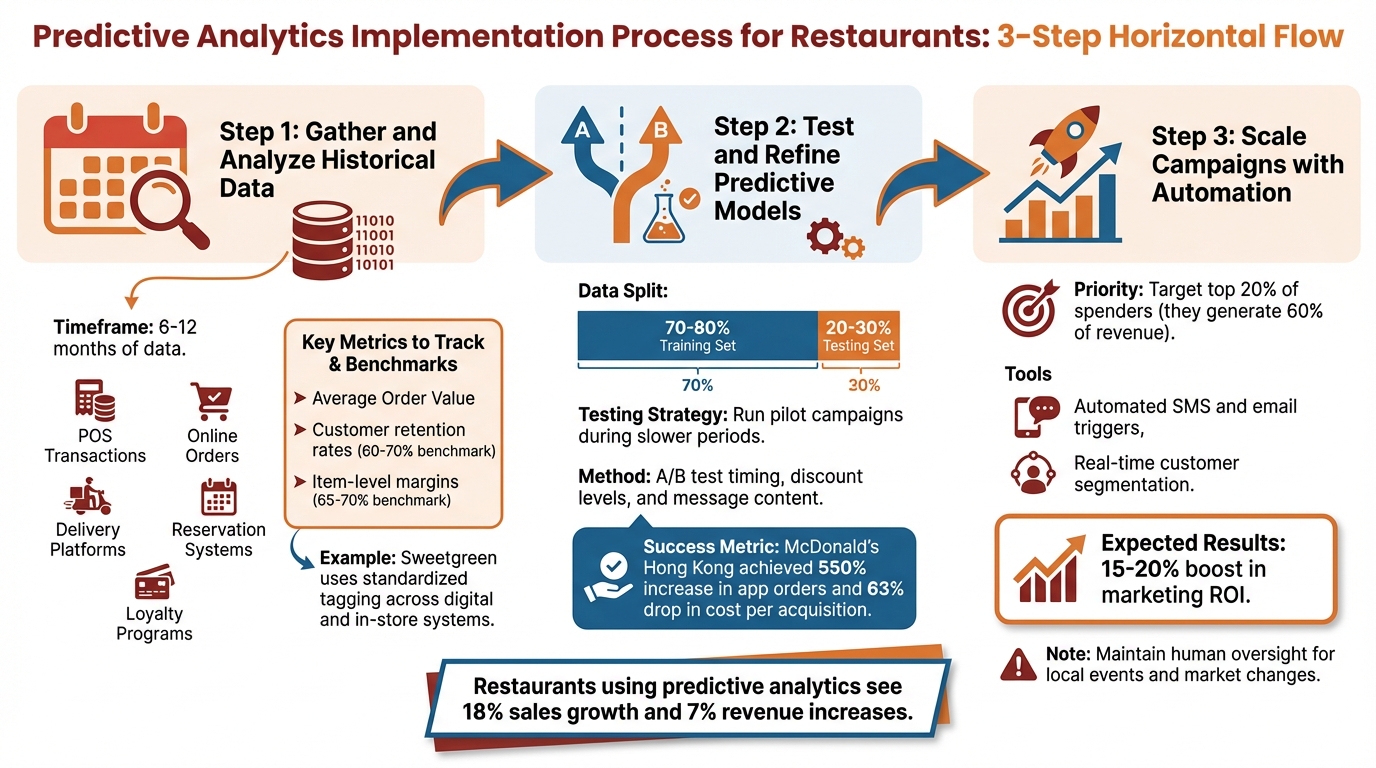
3-Step Implementation Guide for Restaurant Predictive Analytics
To get started, collect at least six to twelve months of historical data. This timeframe helps you identify seasonal patterns and customer trends. The data should come from multiple sources like POS transactions, online orders, delivery platforms, reservation systems, and loyalty programs. Instead of managing separate spreadsheets, aim to consolidate all this information into a single, unified dataset. This approach gives you a clear and comprehensive view of your customers.
With data cleaning already taken care of, ensure the dataset is standardized. That means consistent labels, complete order details, and accurate timestamps. For example, Sweetgreen uses standardized tagging across both digital and in-store systems to track loyal customers and spot those at risk of churning. Focus on key metrics like Average Order Value, customer retention rates (usually between 60% and 70% for stable restaurants), and item-level margins (benchmarked at 65% to 70%). These metrics are essential for making solid predictions.
Once your data is organized and these core metrics are in place, you’re ready to test predictive models.
Begin with simpler models before diving into more advanced forecasting techniques. Start by identifying customers likely to churn or ranking leads based on their past behavior. To ensure your model works as expected, split your historical data into two parts: a training set (70–80%) and a testing set (20–30%). This step helps validate your model’s accuracy before applying it in real-world scenarios.
Use slower periods to run pilot campaigns and test your predictions without taking on too much risk. A good example is McDonald's Hong Kong, which, in 2024, used Google Analytics 4's predictive tools to identify users "likely to purchase soon" or "likely to churn." This strategy led to a 550% increase in app orders and a 63% drop in cost per acquisition. A/B testing can further refine your approach by experimenting with variables like the timing of offers, discount levels, and message content. Regular audits of your models are also critical to ensure they remain accurate over time.
Once you’ve fine-tuned your models, you can move on to scaling your efforts using automation.
After confirming your models are reliable, automation tools can help you scale your efforts. Platforms like Bytes AI can automatically update customer segments in real time as new data comes in. This keeps your campaigns relevant and allows your team to focus more on enhancing the guest experience.
Start by targeting your highest-value customers first. Typically, the top 20% of spenders account for around 60% of a restaurant's revenue. Use predictive insights to create personalized campaigns for these VIP customers, leveraging automated SMS and email triggers. Automation not only reduces manual work but also makes your marketing more responsive. Restaurants that integrate predictive analytics across all channels often see a 15% to 20% boost in marketing ROI.
Once you’re confident, expand automation to broader customer segments. However, keep a human touch in the process to adjust for local events or sudden market changes.
Measuring ROI is essential to confirm that predictive insights translate into measurable outcomes, ensuring campaigns deliver concrete results.
To effectively measure ROI, start by establishing a baseline before launching your predictive marketing campaign. Key metrics to record include Customer Acquisition Cost (CAC), Customer Lifetime Value (CLV), and metrics like slow night fill rates. For accurate comparisons, analyze identical timeframes (e.g., Tuesday lunch compared to Tuesday lunch) while accounting for external factors like weather, holidays, or local events.
Take, for instance, a late 2025 example involving a Montclair farm-to-table restaurant. They shifted their budget from Instagram ads, which had a 35% ROI, to a predictive SMS campaign targeting 3 PM on Tuesdays. The results were striking: Tuesday covers increased by 73% (from 22 to 38), Tuesday revenue jumped by 96% (from $660 to $1,292), and overall marketing ROI soared by 340%.
Using tools like channel-specific promo codes (e.g., SMS15 or INSTA20) paired with UTM parameters can help trace revenue back to specific predictive segments. Research shows that restaurants actively tracking their marketing efforts can see revenue growth up to 23% higher than those that don’t.
This baseline data is crucial for measuring the revenue lift generated by your campaign.
Once baseline metrics are in place, the next step is calculating the revenue lift achieved through your campaign. This is done by subtracting the baseline revenue from the campaign revenue. Advanced methods like Marketing Mix Modeling (MMM) and incrementality testing can confirm that the uplift is directly tied to predictive analytics.
The standard formula for calculating ROI in restaurant marketing is:
ROI = (Net Profit / Cost of Investment) × 100
To find net profit, subtract Cost of Goods Sold (COGS) and all marketing expenses (e.g., ad spend, software fees, staff time) from the total campaign revenue. While the industry average ROI for many restaurants hovers around 10%, predictive analytics campaigns can achieve much higher returns, ranging from 300% to 500% - equivalent to $3–$5 earned for every $1 spent.
Tracking Marginal ROI (MROI) can also help identify the point where additional investments no longer yield significant growth. Predictive analytics platforms often simulate budget scenarios with a margin of error as low as 4%. To ensure accuracy, A/B testing can validate incremental gains, with campaigns tracked for at least 30 days to smooth out short-term fluctuations.
"Predictive analytics marks a turning point in marketing effectiveness. It helps teams move from reactive reporting to proactive decision-making, where every action is grounded in evidence rather than instinct." - Christopher Van Mossevelde, Head of Content, Funnel
These insights not only validate the success of your current campaigns but also feed into refining predictive models and optimizing future marketing strategies, fostering a continuous cycle of improvement.
Predictive analytics takes restaurant marketing from a game of chance to a data-driven strategy. Instead of scrambling to fix campaigns after they underperform, you can forecast outcomes before spending a dime, pinpoint the most effective marketing channels, and tailor promotions to match customer habits and preferences. This proactive approach replaces guesswork with precision, ensuring every marketing dollar works harder.
Here’s a compelling stat: brands leveraging marketing technology see an 18% boost in sales and a 7% increase in revenue. Yet, many still struggle to achieve more than a modest 50% ROI. With predictive analytics, you can make smarter decisions that directly improve profitability.
Start small. Focus on clear goals like cutting down food waste or filling tables on slower nights. Test different budget allocations and channel strategies through pre-launch simulations. Use tools like unique promo codes and UTM parameters to connect revenue directly to specific campaigns. And don’t stop there - monitor your metrics regularly to stay on track. As Livelytics puts it, "Predictive analytics is more than just a trend – it's a transformative force reshaping restaurant operations and growth".
Predicting customer demand is one of the easiest ways for a small restaurant to make smarter decisions. By looking at historical data - like past sales, weather patterns, and local events - you can get a pretty good idea of when your restaurant will be busiest and which menu items will be in high demand. This kind of demand forecasting helps you manage inventory and schedule staff more effectively, all without diving into complicated machine learning tools. It’s a simple yet impactful starting point that can pave the way for exploring more advanced prediction models down the line.
Reliable predictions hinge on having sufficient historical data to spot patterns and trends. This often includes information like customer behavior, sales figures, and operational metrics. The amount of data required can vary depending on the purpose and the tools being used, but collecting detailed and relevant data is essential for producing accurate outcomes.
To show that a campaign’s revenue boost came from predictive targeting, you’ll need to use attribution and measurement methods to connect your marketing actions to revenue results. Start by tracking customer behaviors influenced by the campaign and evaluate how these actions lead to revenue shifts. Using pre- and post-campaign analysis, along with control groups or baseline data, can help you pinpoint the campaign’s specific impact. This approach ensures the revenue increase is accurately tied to your predictive targeting efforts.