
Restaurant Technology
Published February 21, 2026
Leverage POS purchase history, visit frequency, and menu preferences to segment customers, automate personalized emails, and measure revenue impact.

Want to boost your restaurant’s email marketing performance? Start with your POS data.
Your point-of-sale system does more than process payments - it’s a goldmine of customer insights. By leveraging POS data like purchase history, visit frequency, and spending patterns, you can craft personalized email campaigns that drive engagement and increase sales.
Here’s why it matters:
Bottom line? POS data helps you create emails that feel personal, drive repeat visits, and boost revenue.
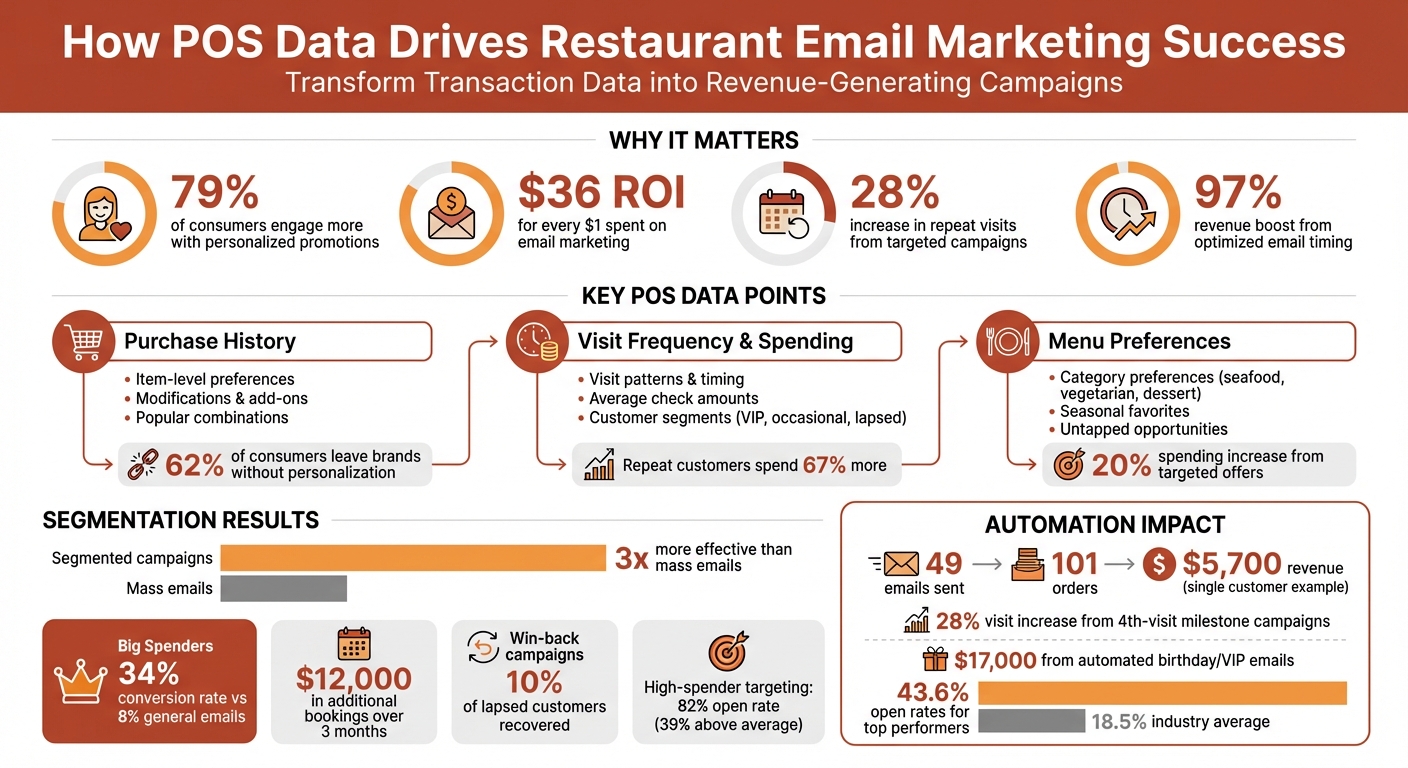
How POS Data Drives Restaurant Email Marketing Success
Your POS system collects a wealth of data, but three key categories stand out when it comes to crafting personalized emails that truly connect with your audience.
Every order your POS records is a treasure trove of insights. It captures item-level preferences, including modifications and add-ons, giving you a clear picture of what customers enjoy. For instance, if someone consistently orders plant-based dishes, you can send them emails about your new vegan menu options instead of highlighting a ribeye steak special. This level of detail matters - 62% of consumers will leave a brand that doesn’t offer personalized experiences.
"Personalization is not just about using someone's name in an email. It's about understanding their needs and preferences and tailoring your marketing efforts accordingly." - Neil Patel, Digital Marketing Expert
Additionally, purchase history can reveal popular combinations, which are perfect for upselling. If a customer regularly orders a burger and standard fries, you might send them an offer for loaded fries or a premium burger upgrade. Beyond that, analyzing visit frequency and spending patterns helps refine your customer segments even further.
Your POS system tracks how often customers visit, when they come in, and how much they spend. This data paints a detailed picture of their habits and preferences. With it, you can identify segments like VIP regulars (frequent, high-spending guests), special occasion diners (weekend visitors with large parties), or lapsed customers (those who haven’t visited in 60+ days). Each group requires tailored messaging: VIPs might enjoy exclusive chef’s table invites, while lapsed guests might respond to a “we miss you” offer with a compelling incentive.
Spending thresholds, such as an average check over $100, can help you pinpoint high-margin customers and send them targeted invites to events like wine pairings. Since repeat customers spend 67% more than new ones, nurturing these relationships is a smart move. Pair these spending insights with menu preferences to create even more focused promotions.
Understanding which dishes perform well - and which don’t - can guide your promotional efforts. POS data reveals category-based preferences, like customers who favor seafood, vegetarians, or those who always order dessert. Use this information to send specific offers: invite seafood fans to a tasting event or let dessert lovers know about your new seasonal pie.
Your POS can also highlight untapped opportunities. For example, if a loyal customer has never tried your high-margin seasonal special, trigger an email showcasing that dish. This strategy can lead to a 20% increase in spending among email recipients over 30 days. For regulars who stick to their favorites, consider creating “one-click” ordering options in your emails, featuring their usual go-to combos.
Once you know what your POS system tracks, the next step is to group customers into meaningful segments. This lets you tailor your messaging to specific groups rather than sending out generic promotions to everyone. Segmented email campaigns are three times more effective at driving conversions than mass emails, making segmentation a smart way to boost your marketing ROI.
Using the insights from your POS data, you can create precise customer segments for targeted communication. For example, segment customers based on their visit frequency: VIPs (5+ visits), occasional diners, and first-timers. Each group can receive tailored messages - VIPs might enjoy exclusive previews of new dishes, while first-timers could get a welcome email introducing your loyalty program.
Spending habits provide another layer for segmentation. Customers who spend over $100 per visit are part of your high-margin segment and deserve premium offers. For instance, a Chicago boutique restaurant created a "Big Spenders" segment for these customers, offering perks like advance wine pairing dinners and chef’s table experiences. The result? A 34% conversion rate (compared to 8% for general emails) and $12,000 in additional bookings over three months. This approach shows how aligning offers with customer value leads to better results.
You can also segment by ordering habits - such as app-only users, delivery customers, or dine-in guests. Time-specific behaviors, like weekday lunch regulars or weekend brunch-goers, allow for promotions that match when customers are most likely to visit.
Your POS system’s "last visit date" is a powerful tool for win-back campaigns. Define what "lapsed" means for your business - whether that’s 30, 60, or 90 days without a visit. Set triggers based on inactivity (e.g., 14 days for VIPs, 60+ days for occasional diners) to automate win-back emails.
Elizabeth Jacobi of MochaBear Marketing helped a fast-casual restaurant launch a re-engagement strategy targeting customers who hadn’t visited in 30 days. The campaign won back 10% of lapsed customers, contributing to nearly 50% of all revenue from the email channel during the campaign period. This highlights how POS-driven segmentation can turn dormant customers into active ones.
Personalize win-back emails by referencing past orders and suggesting similar seasonal dishes. Add an incentive, like a welcome-back discount or free dessert, to encourage their return. Once you’ve re-engaged lapsed customers, focus on creating campaigns that resonate with your most valuable guests.
The top 20% of your customers typically generate 80% of your revenue, so they deserve extra attention. Use metrics like Average Order Value (AOV), Customer Lifetime Value (LTV), and Per Person Average (PPA) to identify these key guests. Since repeat customers spend 67% more than new ones, retaining high-spenders is crucial for your bottom line.
Grecian Gyro, a Greek restaurant in Atlanta, used email segmentation to target their most engaged and highest-spending customers. The campaign achieved an 82% open rate (39% higher than average) and resulted in 34 online orders, generating over $1,300 in sales.
To reward high spenders, offer exclusive experiences like tasting events, early access to new menus, or chef’s table reservations. Set alerts for high-PPA guests (e.g., those spending over $20 per visit) who haven’t returned within their usual timeframe, and send them personalized offers to prevent churn. Recognizing and rewarding these customers strengthens loyalty and turns POS insights into actionable strategies that drive repeat business.
Once you've segmented your customers, the next step is crafting emails that feel personal and relevant. Using POS data, you can tailor your messages to reflect customer preferences and habits, making them far more engaging. Generic promotions just don’t cut it anymore - 79% of consumers are more likely to respond to brands offering personalized promotions based on their previous interactions. By tapping into POS insights, you can create emails that resonate on an individual level. Let’s dive into how referencing past orders can help you do this.
Mentioning a customer’s previous orders in your emails creates an immediate sense of recognition. For instance, if someone frequently orders burgers, you could send them an email suggesting a premium burger upgrade or a side of loaded fries. This kind of personalization works - AI-powered email offers have been shown to boost average order sizes by 17%.
You can also group customers by their menu preferences using POS data. Whether they prefer vegetarian dishes, seafood, or cocktails, targeted recommendations based on these preferences are more likely to grab their attention. For example, if your POS shows a customer consistently orders seafood, an email promoting a new grilled salmon special will connect much better than a generic message.
POS data can also help you time seasonal promotions perfectly. By analyzing sales trends, you can predict when certain items will be in demand. For example, if your data shows hot beverage sales spike every winter for a specific group, you can send them seasonal drink offers before the weather cools. Reviewing at least three years of POS data can reveal patterns, like dessert sales increasing by 60% in December, allowing you to plan your campaigns accordingly.
Another way to use this data is by identifying slow periods through POS "heatmaps." If weekday lunches are consistently quiet, you could send targeted offers like mid-week vouchers or "Late Lunch Perks" to drive traffic during those times. By including unique coupon codes, you can track ROI and measure the success of your campaigns accurately. This approach ensures your efforts are backed by data, not guesswork.
POS data can also enhance your loyalty program emails by making them more timely and relevant. For example, you can send reminders when customers are close to earning a reward, celebrate special occasions, or re-engage lapsed members with incentives tied to their previous orders. These personalized touches keep your program top-of-mind and encourage repeat visits. In fact, email is 40 times more effective than social media platforms like Facebook or X for bringing guests back for a second visit.
You can also use POS data to trigger milestone emails for birthdays or anniversaries, offering personalized gifts like a free appetizer or dessert. For customers who haven’t visited in 30 or 60 days, a "we miss you" email with an enticing offer based on their past orders can bring them back. For example, MochaBear Marketing’s 2025 case study revealed that encouraging first-time customers to return for a fourth visit led to a 28% increase in visits for that segment. These loyalty reminders can turn occasional customers into regulars.
Taking the insights from POS segmentation a step further, automation allows your email marketing to respond dynamically to real-time customer behaviors. By linking your POS system with your email marketing platform, you can instantly launch personalized campaigns. Many modern POS systems integrate seamlessly with ESPs and CDPs, enabling customer actions to trigger tailored messages automatically. The results speak for themselves - email marketing for restaurants boasts an average ROI of $36 for every $1 spent, and automation makes scaling this level of personalization possible.
Gathering email addresses at the point of sale is a crucial first step. Tools like digital receipts, handheld payment devices, and gated Wi-Fi help capture guest emails during checkout. Once integrated, your POS system can fuel timely automated campaigns, from expressing gratitude post-visit to sending event-driven offers.
Automation ensures that your engagement happens right after the transaction, while the experience is still fresh in the guest's mind. This is especially important considering 94% of U.S. diners are influenced by online restaurant reviews. Automated follow-up emails requesting reviews can have a direct impact on your reputation and future business.
Take the example of GIOIA, a restaurant that leveraged automation over an 18-month period ending in 2022. They sent 49 emails to a single guest, 39 of which were fully automated. This strategy led to 101 orders and over $5,700 in revenue from that one customer. Automation can nurture relationships effortlessly, turning occasional diners into loyal patrons.
Beyond follow-up emails, event-based triggers help you connect with customers on a more personal level. POS profiles that include details like birthdays, anniversaries, or loyalty milestones can trigger special offers automatically. For instance, Starbucks sends birthday rewards to members, redeemable only on their birthday, encouraging immediate visits. You could implement a similar strategy - perhaps offering a free appetizer or exclusive seating for milestone celebrations.
One fast-casual restaurant analyzed its POS data and found that customer loyalty often solidified after the 4th visit within 30 days. By automating emails to encourage first-time guests to reach that milestone, they achieved a 28% increase in visits for that group. Using an Audience Optimizer tool to fine-tune send times based on POS data, they also experienced a 97% boost in total email revenue.
Automation also helps bring back guests who haven't visited in a while. By monitoring the "last visit date" in your POS, you can set thresholds - like 30 days for fast-casual dining or 60 days for fine dining - and trigger re-engagement emails offering discounts. For example, Ocean State Sandwich Company used automation to welcome new VIP followers and send birthday greetings. These efforts alone generated $17,000 of the restaurant's total $48,000 in online ordering revenue. Adjust your thresholds based on your restaurant's dynamics to reconnect with guests before they drift away completely.
Using integrated POS data doesn’t just help tailor your outreach - it also provides a clear way to measure its impact. Tracking what happens after your emails are sent is crucial. Your POS system can reveal whether those campaigns are driving revenue or just encouraging clicks. As Katelyn Andrews from SevenRooms explains:
"The truth is email success is measured in both engagement and revenue, and you should be tracking both for every email that you send".
One way to measure how well your email campaigns perform is by connecting promotions to your POS data. For instance, assigning promo codes like FREEBITES or WEEKEND20 allows your POS system to track redemptions and directly link revenue back to specific campaigns.
A great example of this approach comes from the Altamarea Group. In 2021, they sent targeted emails to 47,000 recipients, leveraging integrated reservation and online ordering data. By tracking redemptions through their POS system, they confirmed the campaign generated $340,000 in reservation revenue and $60,000 in online ordering revenue, with each email averaging $7.43 in earnings. This kind of insight not only justifies marketing budgets but also helps identify strategies worth scaling.
But revenue isn’t the only metric to consider - understanding how customers engage with your campaigns can provide even deeper insights.
While revenue shows the financial impact, engagement metrics reveal how customers are responding. One key metric is the redemption rate, which measures the percentage of recipients who actually use the offer. This can help you evaluate how relevant your campaigns are.
You should also compare your open rates to the restaurant industry average of 18.5%. For top-performing brands, open rates in 2025 are hitting 43.6%. Click-through rates, which typically range from 1.13% to 2%, can show how well your subject lines and offers resonate with your audience.
Beyond email-specific metrics, POS data can uncover behavioral trends, like whether your campaign increases visit frequency or boosts average order values. Eric Handwerger, owner of Ocean State Sandwich Company, highlights the value of this data:
"What I like about Popmenu is that you can see a return on your investment. You send out a mass email about a special or your daily soups and you can watch orders come in".
His restaurant earned over $39,000 in online ordering revenue in a year, with 43% of that coming from automated emails.
Once you’ve gathered revenue and engagement data, the next step is to fine-tune your strategy.
POS analytics offer a powerful way to refine your marketing efforts. For example, you can A/B test different incentives - like a 20% discount versus a free menu item - and use redemption data to determine which offer performs better. If certain customer segments consistently ignore your emails, it might be time to tweak the timing or content of your messages.
Regular POS reports synced with your marketing platform can help you quickly identify trends and make adjustments. If specific menu items consistently drive high redemption rates, consider featuring them more prominently in future campaigns. Kaitlyn Kolacy, Director of Operations at GIOIA Pizzeria, underscores the importance of this data-driven approach:
"Being able to pull actual numbers and progress and show it to the owners to back up my decisions is invaluable".
Thanks to this strategy, her restaurant refined its messaging based on customer preferences, earning over $897,000 in online ordering revenue in 2022.
Your POS data holds the key to transforming email campaigns from generic messages into personalized, revenue-boosting tools. Beyond just tracking transactions, your POS system offers a treasure trove of insights - purchase history, visit frequency, and menu preferences - that can make your emails feel relevant and tailored. Research shows that personalization driven by data yields an impressive 5-8x ROI on marketing investments, while behavior-triggered emails outperform traditional newsletters by a staggering 247%.
This shift from untargeted campaigns to precision-focused marketing isn’t just a passing phase - it’s quickly becoming the norm for restaurants aiming to stay competitive. Take First Watch, for example. By sending automated emails to new customers 14 days after their initial visit, they achieved a 57% visit rate among those who opened the emails and generated $2.7 million in guest spending in just 90 days.
Integrating your POS with your email platform makes all of this possible. It enables automated, personalized messages - like win-back campaigns, birthday offers, and post-visit follow-ups - without the need for manual data entry. This not only ensures your messages are timely and relevant but also saves marketing teams around 15-20 hours per week.
Restaurants that succeed in data-driven marketing use these insights to create consistent, action-oriented campaigns. They re-engage at-risk customers before losing them, reward loyal patrons with exclusive perks instead of generic discounts, and measure success by sales impact rather than simple metrics like open rates. Experts agree that adopting this approach is easier than you might think and delivers results quickly.
If you’re ready to elevate your email marketing, consider integrating your POS with a platform like Bytes AI. It combines order aggregation, customer data management, and marketing automation into one system. Their upcoming POS solution, designed specifically for modern restaurants, offers everything you need to turn transaction data into a loyal customer base.
To begin, focus on customer purchase history, visit frequency, and preferred menu items. These details allow you to divide your audience into meaningful groups, such as loyal customers, occasional visitors, and first-time guests. With this segmentation, you can craft email campaigns that are tailored to each group, delivering messages that feel personal and relevant to their preferences.
To tie POS purchases to email revenue, start by using your POS system to track customer transactions and link them to individual profiles or email addresses. Gather details such as the transaction amount, purchased items, and customer identifiers. Then, sync this data with your email marketing platform. This connection allows you to accurately attribute revenue to specific email campaigns, evaluate their performance, and boost ROI by sending personalized offers based on the insights from POS data.
Reconnecting with lapsed guests can be surprisingly effective with the right automations. One of the best strategies? Personalized email campaigns. By tailoring offers based on past purchases, you can grab their attention and encourage them to return.
For example, consider sending:
Leveraging POS data to segment your audience ensures these messages hit the mark. When emails feel relevant and well-timed, it’s easier to recover lost customers without putting in a ton of extra effort.