
Restaurant Technology
Published March 3, 2026
Compare top sentiment analysis tools for restaurants, with pricing, accuracy, integrations, and recommendations for small to enterprise operations.

In 2026, managing a restaurant's online reputation is critical. With 94% of diners checking reviews before booking and 53% avoiding restaurants rated below four stars, sentiment analysis tools have become essential for success. These tools use AI to analyze feedback from platforms like Google, Yelp, and TripAdvisor, helping restaurants respond to issues quickly and improve customer experience. Here's a quick look at the top tools:
Quick Comparison:
| Tool | Key Feature | Starting Price | Ideal For |
|---|---|---|---|
| iOrders Smart AI | QR-based feedback, POS integration | Custom pricing | Small to medium restaurants |
| Sprout Social | Social media sentiment | $199/seat/month | Medium to large operations |
| Hootsuite | Multi-channel monitoring | $149/month | Small businesses |
| Brand24 | Emotion tracking, 95% accuracy | $149/month | Small to medium businesses |
| Medallia | Enterprise-grade insights | Custom pricing | Large chains |
| Dialpad | Real-time voice sentiment | $15/user/month | Restaurants with high call volumes |
| Semantria | Custom NLP for restaurants | $250/month | Large-scale operations |
| SentiSum | AI for churn prediction | $3,000/month | Medium to large restaurants |
| Black Box Intelligence (BBI) | Industry-specific sentiment | Custom pricing | Large chains with 1,000+ locations |
| FeedbackRobot | Affordable feedback solutions | $49/month | Small to large operations |
Each tool offers unique advantages based on your restaurant's size and needs. For small businesses, FeedbackRobot and iOrders are affordable and efficient. Medium-sized operations may benefit from Brand24 or SentiSum. Larger chains should consider Medallia or Black Box Intelligence for enterprise-grade insights.
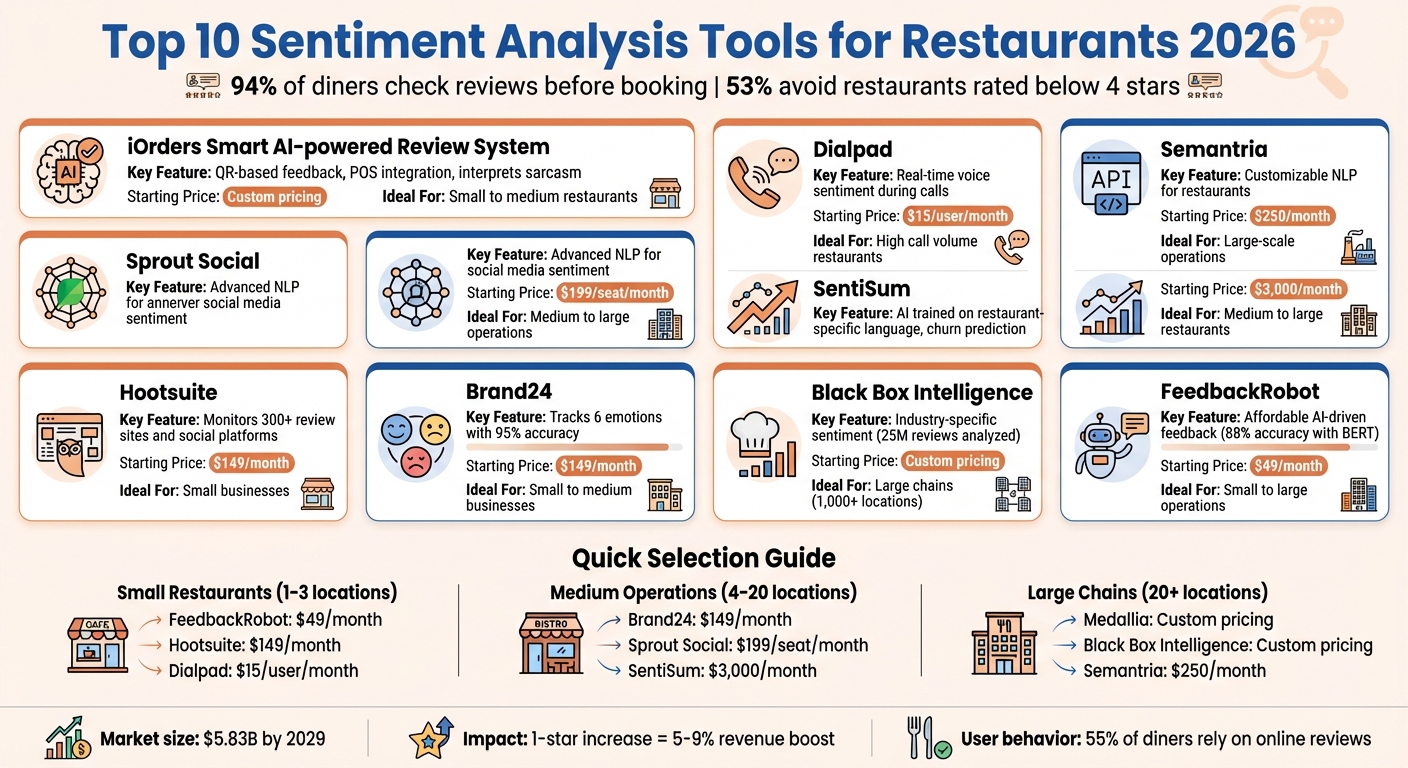
Top 10 Restaurant Sentiment Analysis Tools Comparison 2026
The iOrders Smart AI-powered Review System taps into a vast database of restaurant reviews to expertly navigate culinary lingo. It can interpret phrases like "the restaurant was dead" (indicating low attendance) or "sick plating" (a compliment on presentation) with ease. Its sophisticated contextual analysis even picks up on sarcasm and untangles mixed emotions within a single review.
Beyond its sharp review analysis, iOrders excels at monitoring feedback across multiple channels. It pulls insights from Google, Yelp, social media, direct surveys, and QR-based ordering platforms, all into one user-friendly dashboard. This unified setup streamlines review management and provides real-time insights, helping restaurants act quickly to address concerns.
For restaurant chains with multiple locations, iOrders processes hundreds of reviews in mere seconds. Its interactive dashboards highlight sentiment trends, making it easy to spot and address underperforming locations swiftly.
iOrders seamlessly integrates with its own Online Ordering, Website, and QR-based ordering systems to automatically gather post-dining feedback. This allows restaurants to link customer sentiment directly to key performance metrics. It also connects with popular POS systems like Toast, Square, Lightspeed, and Revel Systems, transforming existing setups into AI-driven hubs - no expensive hardware upgrades required.
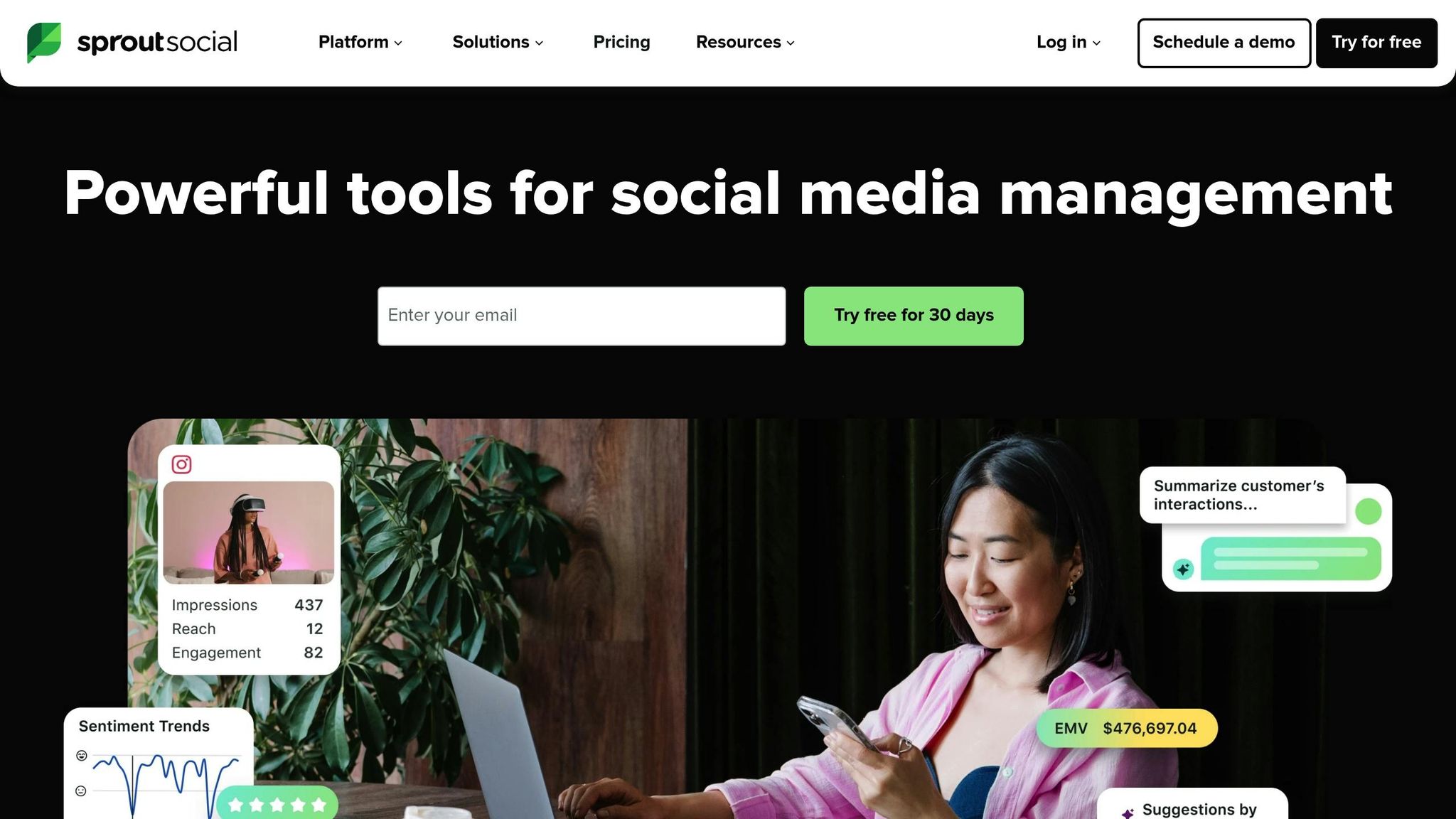
Sprout Social offers enterprise-level sentiment analysis tailored for restaurant brands, using advanced natural language processing (NLP) to interpret casual language, including emojis, slang, and sarcasm. For example, it understands that a phrase like "this food is sick" is a compliment, not a complaint. Its Aspect-Based Sentiment Analysis (ABSA) goes a step further, breaking down feedback into specific areas - helping you pinpoint when a customer loves your food but isn’t happy with the service. This precise analysis enhances the overall social monitoring experience [18, 19].
Sprout Social’s advanced NLP ensures thorough monitoring across multiple platforms. Feedback is gathered from social media sites like Facebook, Instagram, X (formerly Twitter), TikTok, LinkedIn, and Reddit, as well as review sites like Google Business Profile, Yelp, and Tripadvisor. This information is organized into a Smart Inbox, which automatically tags messages by sentiment. Supporting over 30 languages, the system helps restaurant teams quickly address negative feedback, even in diverse markets [18, 22].
Designed to handle high volumes, Sprout Social processes millions of comments and API calls daily. It flags significant sentiment drops - like a 10% decrease in daily sentiment - as early warnings for potential PR crises. Automated rules can route negative messages directly to senior managers, a critical feature when 73% of social media users expect brands to respond within 24 hours. For large restaurant chains, this ensures every review is addressed and used to improve operations quickly [18, 19].
Pricing starts at $199 per seat/month, with higher tiers offering more extensive social listening tools. While it integrates with popular CRMs like Salesforce and help desk software like Zendesk, it doesn’t currently connect directly to restaurant-specific POS or reservation systems [18, 20].
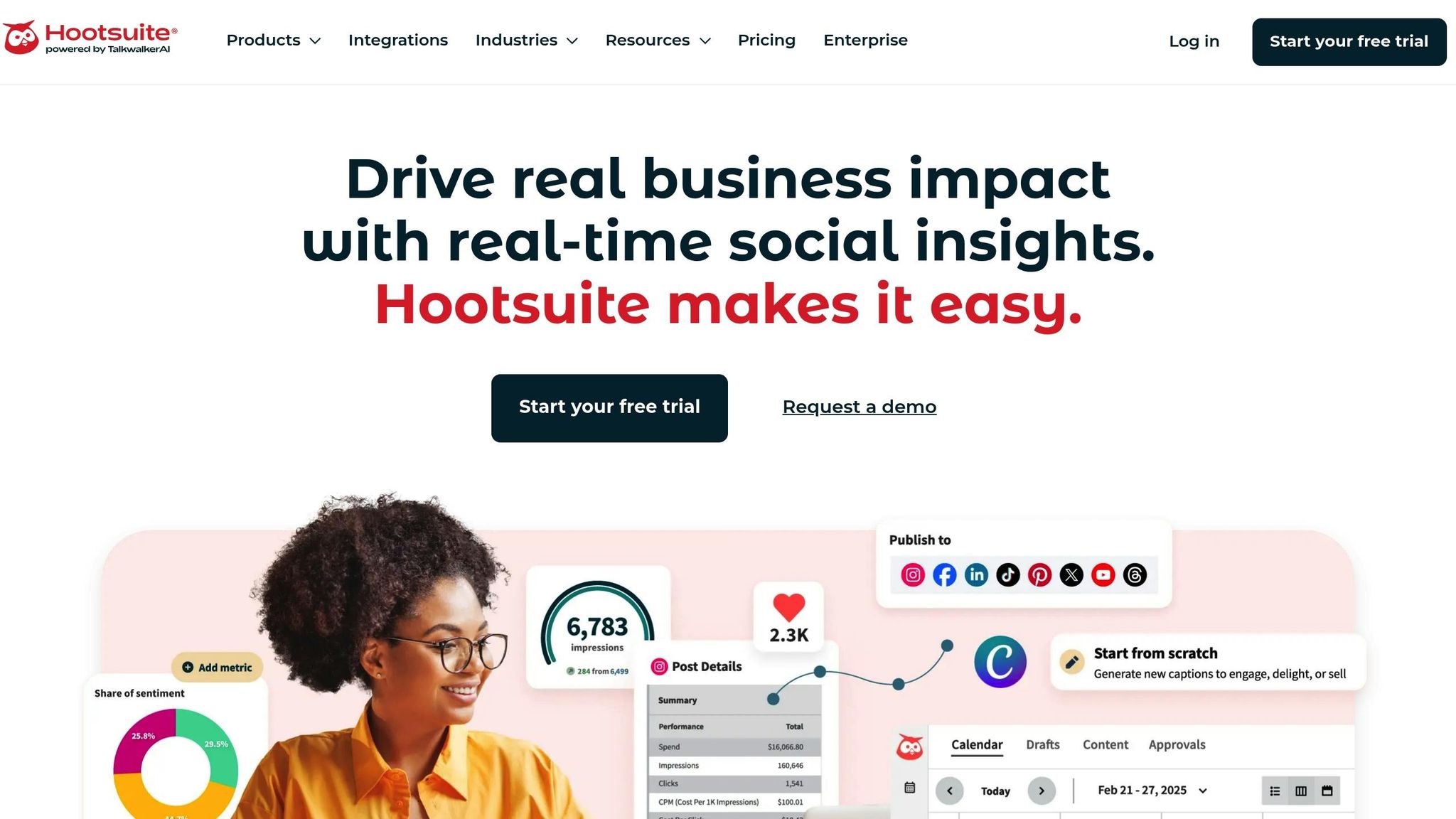
Hootsuite uses Talkwalker's AI-driven sentiment analysis to understand full sentences with context and nuance. Instead of focusing solely on keywords, it can interpret phrases like "this pizza is sick" or "I'm dying for these tacos" as positive compliments.
This advanced sentence analysis allows Hootsuite to provide insights across a variety of platforms.
Hootsuite keeps an eye on over 300 review sites and more than 30 social platforms, including restaurant-focused channels like OpenTable, Zomato, Tripadvisor, Yelp, and Google My Business. Its BlueSilk™ engine goes beyond text, analyzing images, videos, and audio. It can even identify logos or food items in untagged content. Real-time alerts notify users of negative trends, enabling quick responses to potential crises.
"The insights that Talkwalker provides us have been incredible and have really informed our campaign strategy."
- Liz Grey, Social Media, University of Sydney
Although Hootsuite doesn’t directly integrate with POS systems, it works with ReviewTrackers to gather reviews from over 85 sites, including OpenTable, into one dashboard. This unified approach is essential for real-time review management in today’s restaurant industry. Additionally, it offers API and web scraping options to pull data from platforms it doesn’t natively support. The "Share of Emotion" feature provides a visual breakdown of guest sentiment - like joy or anger - helping managers identify when food might be praised while other aspects of the experience fall short.
Pricing begins at $149/month for the Standard plan, with Professional ($299/month) and Advanced ($399/month) plans offering additional features. Enterprise-level pricing includes access to historical data going back to 2010 and over 100 integrations.
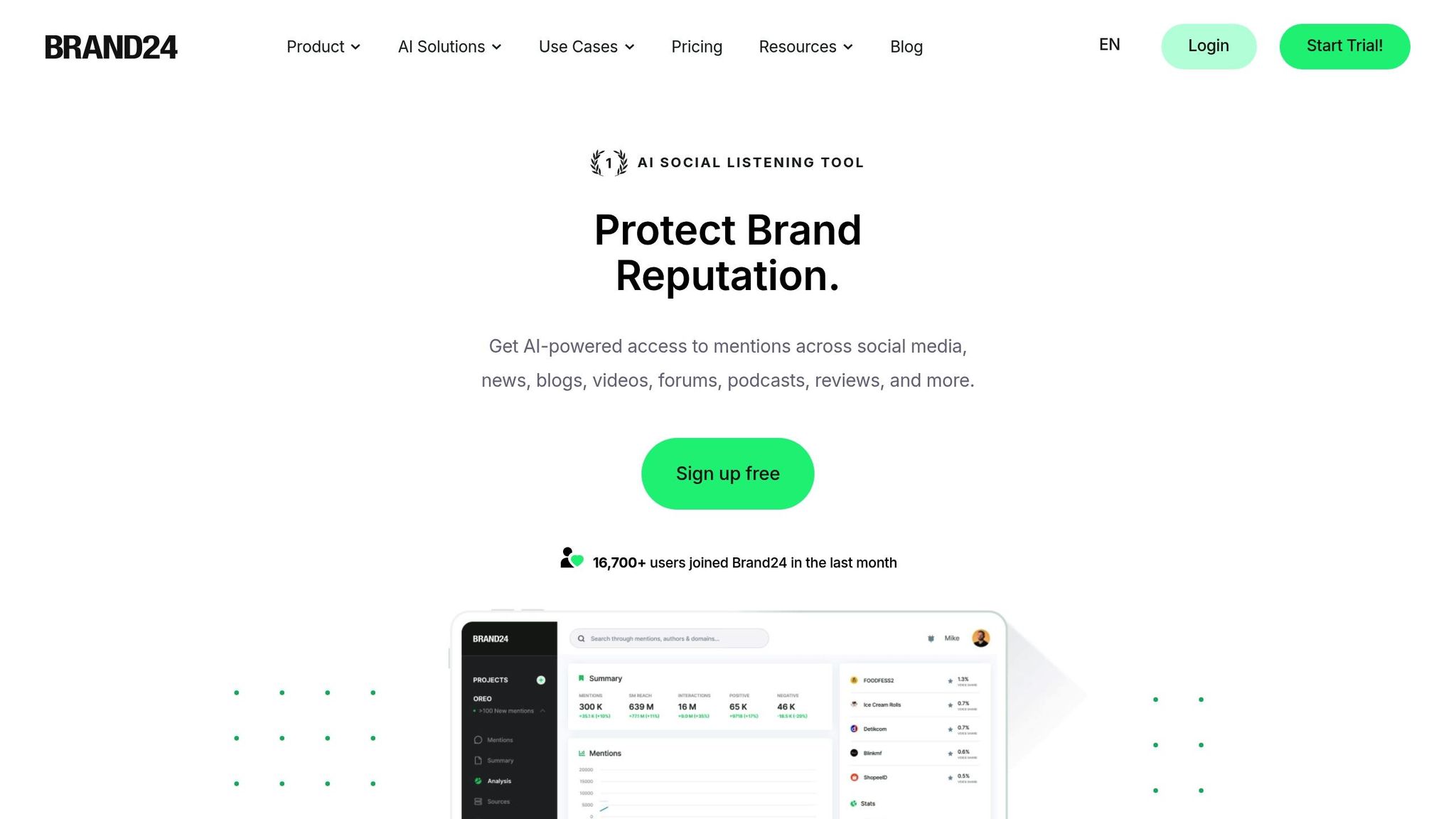
Brand24 stands out for its impressive 95% accuracy rate in sentiment detection, measured by the macro-averaged F1-score. Using Deep Learning and pre-trained language models, it analyzes restaurant reviews and social mentions in a way that mirrors human interpretation. Plus, it allows manual corrections, which improve its precision over time.
Brand24 takes emotion detection to another level. Instead of just categorizing feedback as positive, negative, or neutral, it identifies six distinct emotions - admiration, anger, disgust, fear, joy, and sadness. It even considers emojis and the surrounding context to better understand tone. This level of detail helps restaurant managers grasp how customers feel about specific aspects of their operations.
For example, PepsiCo leveraged Brand24 in 2025 to achieve remarkable results: a 25% increase in positive mentions, a 15% drop in negative reviews, and a 30% boost in engagement, all driven by AI-powered insights.
"Despite having a large team dedicated to customer experience, using Brand24 revealed some surprising insights. It flagged details like, 'This user has made 14 comments,' which proved to be incredibly useful."
- Krzysiek Radoszewski, Marketing Lead, Central & Eastern Europe, Uber
Brand24 monitors an impressive 25 million online sources in real-time, covering review sites, social media platforms, news outlets, blogs, podcasts, and forums. Its Storm Alerts feature sends instant notifications via Slack or email whenever there’s a sudden spike in negative sentiment, enabling swift crisis management.
The platform’s AI Brand Assistant simplifies feedback analysis by responding to natural language queries like, “What drives negative sentiment for our new menu?” This eliminates the need to sift through every comment individually.
These tools make Brand24 especially suited for businesses handling high volumes of customer feedback.
Designed for large-scale operations, Brand24 is trusted by over 4,000 brands worldwide. It offers customizable dashboards and automated reporting, making it easier to monitor multiple locations with keyword tracking. For restaurant chains, the Geo Analysis feature pinpoints which cities or regions are generating the most buzz - whether positive or negative.
Pricing starts at $149/month for tracking 2,000 mentions with 12-hour updates. For $299/month, you can track 5,000 mentions with hourly updates, while the $399/month plan includes real-time monitoring and advanced features. Enterprise plans and a 14-day free trial are also available.
Medallia offers enterprise-level tools for restaurant sentiment analysis, processing over 1 billion feedback signals every month. It’s trusted by 7 of the Fortune 10 companies, showcasing its reliability and performance. At the core of its service is the Athena AI Engine, which analyzes omnichannel feedback in real time. This system doesn’t just identify positive or negative sentiment - it pinpoints specific emotions, customer intent, and effort across multiple languages.
Medallia’s Natural Language Understanding (NLU) technology dives deep into customer feedback, uncovering insights beyond basic sentiment. By leveraging supervised machine learning, it identifies themes, intent, empathy, and even nuanced emotions. This allows restaurants to pinpoint what impacts customer experiences - be it food quality, service efficiency, or the overall atmosphere.
Medallia integrates seamlessly with Point of Sale (POS) and ERP systems, capturing experience signals from both known and anonymous customers. With its flexible APIs and ETL capabilities, it connects with virtually any technology stack, including older systems. Pre-built connectors are also available for popular enterprise platforms like Salesforce, Adobe, and various CRM tools.
By linking sentiment data to transactional details such as menu preferences and service times, Medallia provides actionable insights. Its Frontline-Ready AI equips franchisees and managers with role-specific dashboards and automated alerts, enabling them to address customer concerns promptly.
Medallia is built to support multi-location restaurant operations, offering corporate leaders a view of overarching brand trends while providing branch managers with location-specific insights. Real-time data can be accessed through mobile apps for iOS and Android, allowing managers to respond to alerts on the go. Users have reported impressive results, including up to 185% ROI over three years and 87.2% of customer alerts resolved within 72 hours.
Pricing is tailored to each business, depending on the data volume and modules required, making it a great fit for both fast-growing startups and large franchise networks.
Dialpad takes sentiment analysis into the realm of real-time voice interactions, going beyond just text reviews. Its AI is designed to analyze live customer calls, delivering sentiment insights as conversations happen. With training based on over eight billion minutes of call data, Dialpad's technology can gauge satisfaction levels, recognize phrases like "I'm not happy", and accurately transcribe a variety of accents, including those from the US, Australia, and New Zealand. This ensures fewer errors and better understanding during customer interactions .
Dialpad's system works in real time, transcribing calls live while analyzing customer sentiment as the discussion unfolds . Managers can oversee all active calls through the "Active Calls" tab, making it easier to manage multiple locations. The platform also uses AI to infer CSAT scores for every call, removing the need for traditional post-call surveys. Additionally, the Custom Moments feature allows businesses to track specific keywords - like "undercooked" or "cold food" - helping to identify and address recurring problems.
This focus on voice-based sentiment analysis adds a deeper layer to the tools shaping sentiment management in 2026.
While many platforms focus on scanning social media, Dialpad zeroes in on direct customer interactions. It captures insights from voice calls and live chats, covering everything from support queries to order and reservation requests .
Dialpad functions as a standalone platform, featuring Real-Time Assist (RTA) cards that provide instant talking points when specific keywords are mentioned during a call. This helps ensure consistent communication across franchise locations . Pricing starts at $15 per user per month and goes up to $150, with sentiment analysis included in all Dialpad Support plans at no additional cost.
Semantria delivers sentiment analysis tailored for restaurants through a RESTful API built on Lexalytics' NLP technology, refined over nearly two decades. Its cloud-based system processes millions of reviews daily and includes a Restaurant Industry Pack designed to track diner sentiment on aspects like food quality, staff behavior, and service efficiency.
Using machine learning and NLP, Semantria digs deep into customer feedback, capturing nuanced sentiments. It doesn’t just assign basic scores - it identifies specific entities in reviews, enabling detailed analysis with industry-relevant terms. For example, it can highlight phrases like "plating presentation" for fine dining or "drive-thru speed" for fast-food outlets.
The platform supports analysis across multiple channels, including direct feedback and social media, in 29 languages. It connects seamlessly to internal databases, data warehouses, and external text streams, offering a broad view of customer sentiment. For teams without dedicated tech resources, integrations with tools like Zapier and an Excel add-in simplify tasks like survey response analysis.
These features make it an excellent fit for large-scale operations.
Built for high-volume needs, Semantria is ideal for restaurant chains, offering deployment options like public, private, hybrid, or on-premise setups to address security and scalability requirements. Chains can customize entities and brand-specific vocabularies - for instance, grouping mentions of "NYC location" and "Manhattan store" for more cohesive reporting. Pricing starts at $250 per month, with custom quotes available for enterprise-level data and processing demands.
Semantria works with restaurant platforms such as POS and reservation systems. Developers can embed sentiment insights into custom dashboards or workflows, while the Restaurant Industry Pack provides ready-to-use configurations. Real-time monitoring integrations with tools like Slack and BigQuery allow managers to receive instant alerts when negative feedback trends emerge.
SentiSum takes AI-driven sentiment analysis to the next level with its custom-built models designed specifically for each restaurant's unique needs. By training its AI on industry-specific terms and customer feedback, the platform can pick up on subtle differences in language. For instance, it understands that "not bad" leans positive, while a comment like "great, another bug" conveys frustration. This nuanced understanding, powered by advanced language models, achieves a reported accuracy rate of 85–95% in detecting sentiment. This precision makes it a standout option for restaurants looking to refine their customer experience.
At the core of SentiSum’s effectiveness is its Kyo AI engine, which has been fine-tuned through over a decade of customer research. Capable of processing up to 16,000 texts per second, the system adapts automatically to your restaurant’s specific jargon without the need for manual data cleanup. It also identifies potential customer churn up to 30–60 days in advance.
"With SentiSum in place, we quickly spotted an issue affecting dozens of drivers daily - a missed tech fix that was costing us thousands in revenue." – Steven Burt, Senior CX Director
SentiSum consolidates feedback from a variety of sources into a single, user-friendly dashboard. Whether it’s support tickets, phone calls, surveys, online reviews, social media, or CRM notes, the platform brings it all together. It supports sentiment analysis in over 100 languages, making it ideal for restaurant brands with a global footprint. For phone-based feedback, SentiSum offers real-time transcription and sentiment analysis, with voice analysis services priced between $0.04 and $0.06 per minute for enterprise clients. Its "Early Warning Agent" feature is particularly useful, flagging sudden increases in complaints - like delivery delays or food quality issues - so you can address problems before they escalate.
Designed to manage operations at scale, SentiSum handles millions of customer interactions across multiple locations. It integrates seamlessly with over 100 platforms, including Zendesk, Salesforce, and Trustpilot, and also offers API access for custom tool connections. During onboarding, the platform analyzes 6 to 12 months of historical data to fine-tune its AI for your restaurant’s specific needs. Pricing starts at $3,000 per month for up to 5,000 conversations under the Pro Plan, with custom pricing available for larger restaurant chains requiring more extensive data analysis and API integration.
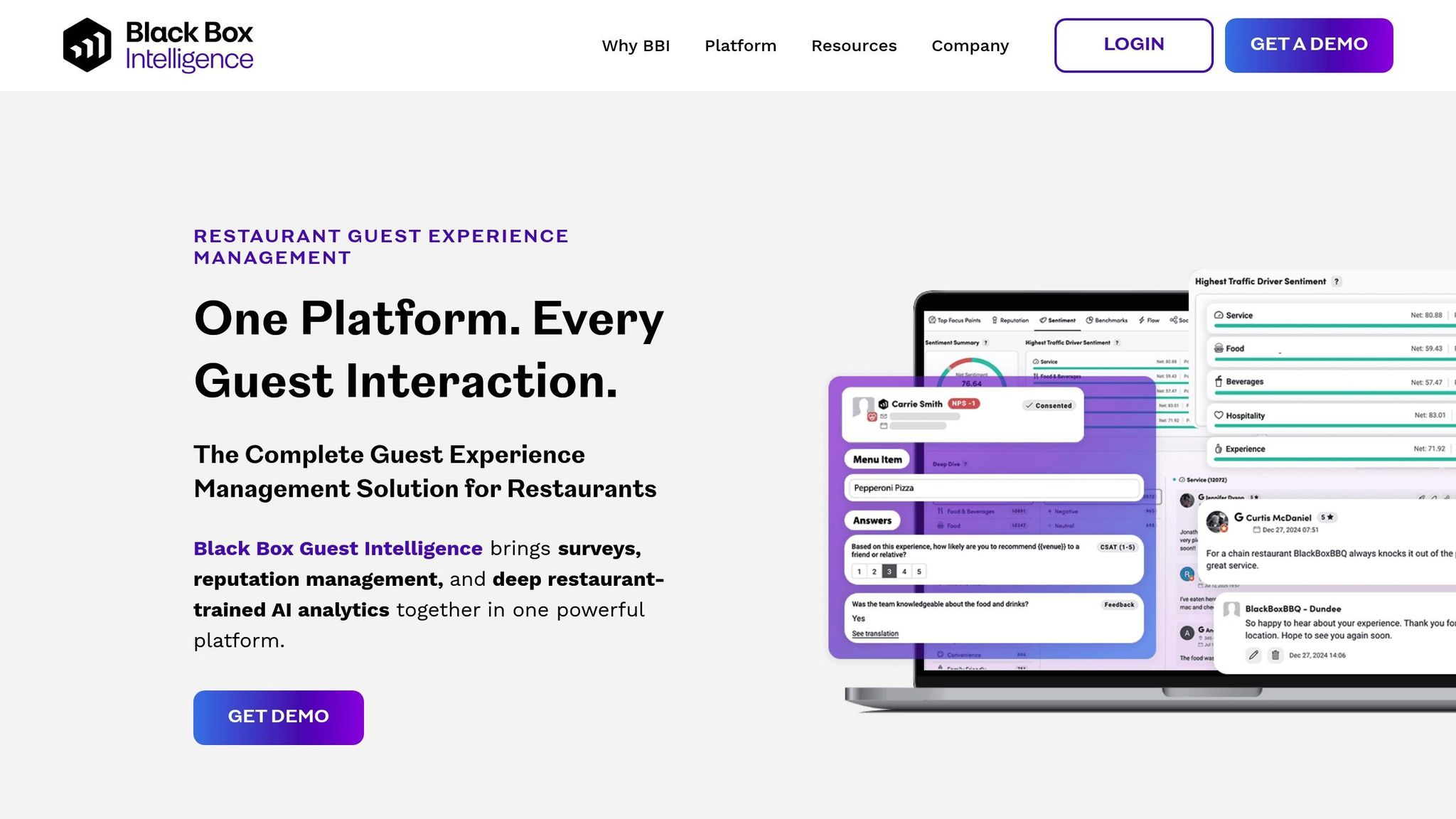
Black Box Intelligence (BBI) is a sentiment analysis tool designed specifically for the restaurant industry. Unlike general-purpose platforms, its AI has been trained on 25 million restaurant reviews and 3 million annotated data points. This specialized training enables it to grasp restaurant-specific nuances. For instance, it understands that "temperature" could refer to food in a steakhouse but ambiance in a café. It also distinguishes between subtle phrases like "service was fine" and "the server made the night".
BBI's Natural Language Processing (NLP) engine leverages over 15 years of restaurant data to deliver highly accurate sentiment analysis. The platform doesn’t just rely on keywords - it interprets the context and emotions behind guest feedback. One restaurant group even saw a 1.5-star boost in their online reputation scores after adopting the system.
"I've not come across a better system of gaining actionable guest feedback in the moment." – Chris Westcott, CEO, Iron Hill Brewery & Restaurant
The platform collects and consolidates data from multiple sources, including online reviews, social media platforms like Facebook and Instagram, and menu-level surveys, all into a single "Reputation Hub". What sets it apart is its ability to link guest sentiment with financial and workforce data, helping restaurants measure the dollar impact of operational changes. Additionally, the "Top Focus Points" feature uses AI to identify which areas - such as service speed or food quality - will yield the greatest return when addressed.
BBI is built to support large, multi-location brands, currently serving restaurant chains with over 1,000 locations worldwide. It provides detailed insights at every level, from brand-wide trends to individual location performance and specific guest comments. Restaurants that improved their sentiment scores experienced 0.5% higher sales growth, while those achieving top-tier sentiment improvements saw 8x higher traffic growth between 2019 and 2023.
"With over 1000 locations worldwide, we need to have a strong pulse on the brand experience. BBI's solutions mean that the quality of service and value of our offerings are always aligned to the broader brand vision, regardless of region or franchise." – Mike Woida, President International, CKE Restaurant Holdings, Inc.
BBI seamlessly integrates with existing restaurant technology, including POS systems, to provide a unified view of performance. This integration ensures that marketing, operations, and finance teams all work with real-time data. Additionally, the platform's Restaurant Performance Network allows brands to benchmark their performance against competitors, helping them identify whether sentiment changes are isolated to their brand or reflect broader market trends.
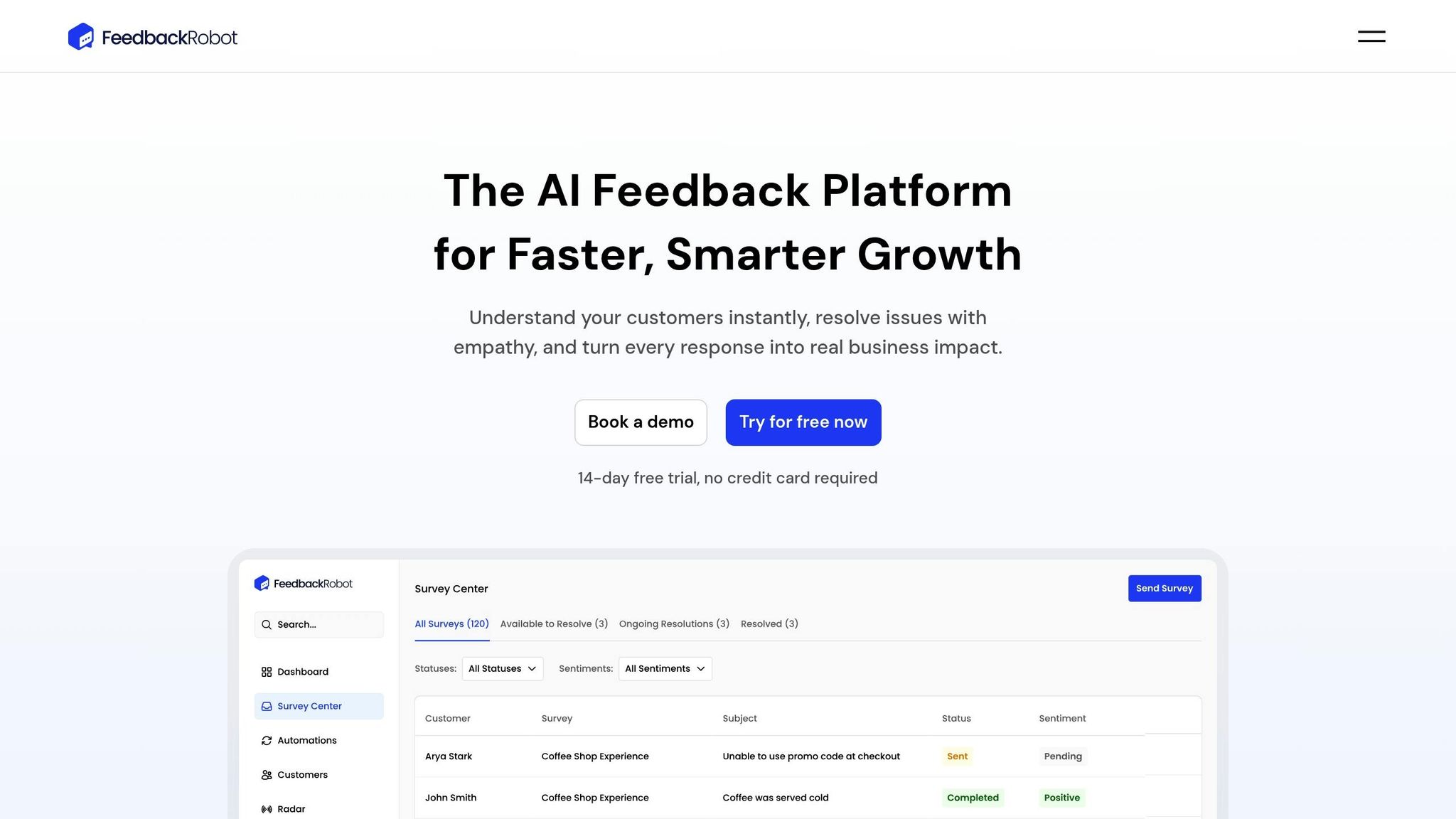
FeedbackRobot is an AI-driven feedback platform designed to transform customer reviews into real-time sentiment insights. Using a mix of lexicons, emoticon analysis, and machine-learned patterns, it identifies nuances like slang, sarcasm, and evolving language trends. Sentiment is categorized into polarity (positive, neutral, negative) and intensity levels. The platform’s sentiment analysis pipelines are fine-tuned to achieve impressive accuracy rates, with testing on a 1,000-review dataset showing results ranging from 70% accuracy with lexicon-based methods to 88% when utilizing BERT, a Transformer-based deep learning model.
To ensure consistent performance, FeedbackRobot actively monitors for "model drift" and retrains its algorithms whenever accuracy falls below certain thresholds. One standout feature, "AI Summaries", condenses hundreds of customer comments into actionable insights, helping businesses identify recurring issues like menu complaints or service delays. For example, a regional restaurant group using automated triggers from the platform saw a 25% drop in negative reviews within three months. Similarly, a hotel chain leveraged the "Resolutions Engine" to cut its negative feedback resolution time by 40%.
FeedbackRobot consolidates feedback from a wide range of sources, including Google, Yelp, TripAdvisor, Facebook, Instagram, X (formerly Twitter), Reddit, SMS, email, and QR codes, all within a single, unified dashboard. Direct feedback is gathered via QR codes, SMS, email, or website forms. The platform’s automated Resolutions Engine further enhances service recovery by initiating actions like crafting empathetic responses or issuing discount codes. This streamlined approach has reduced service recovery times by 30% across 50 stores. These tools create a rapid feedback loop, enabling businesses to address issues almost immediately.
FeedbackRobot seamlessly integrates with Toast (a Restaurant POS system) and Mews (a Hospitality PMS) via API, automatically funneling reviews into its dashboard. Setup is quick, taking just 10 minutes for Mews and 15 minutes for Toast. Additionally, it connects with Salesforce (CRM) and supports custom API endpoints. Pricing starts at $49 per month for the Starter plan, $99 per month for the Growth plan, and $199 per month for the Scale plan, which includes advanced automation, custom domains, and API access. Customers who opt for annual billing receive a 15% discount, and there’s a 14-day free trial available that doesn’t require a credit card.
The table below breaks down the features of top sentiment analysis tools, focusing on accuracy, integration options, pricing, and suitability for restaurants of different sizes.
| Tool | Sentiment Accuracy | Key Integration Options | Starting Price | Ideal For |
|---|---|---|---|---|
| iOrders Smart AI-powered Review System | High (AI-powered) | Online ordering platforms, review sites | Custom (affordable) | Small to medium restaurants managing online presence |
| Sprout Social | Excellent | Social media platforms, Salesforce, Slack | $199/seat/month | Medium to large operations prioritizing social media sentiment |
| Hootsuite | Good | Facebook, Instagram, TikTok, basic CRM tools | $22/month | Small restaurants exploring social listening |
| Brand24 | ~80% accuracy | Social platforms, basic API access | $149/month | Small to medium businesses tracking brand mentions |
| Medallia | Advanced AI (90%+) | Omnichannel (web, mobile, in-person, voice) | Custom enterprise pricing | Large chains with 100+ locations |
| Dialpad | Real-time voice analysis | Phone systems, CRM platforms | $15/user/month | Restaurants with high call volumes for orders and reservations |
| Semantria | Highly customizable | REST API, SDK for custom builds | Custom enterprise pricing | Large operations requiring proprietary integrations |
| SentiSum | High (auto-tagging) | Zendesk, Intercom, Freshdesk, HubSpot | Custom quote-based | Medium to large restaurants handling heavy support ticket volumes |
| FeedbackRobot | Up to 88% (BERT model) | Toast POS, Mews PMS, Salesforce, custom APIs | $29/month | Small to large operations focusing on automated service recovery |
This table helps you pinpoint the tool that aligns with your restaurant's size and operational goals.
Effective sentiment analysis plays a key role in shaping brand reputation, especially in the competitive restaurant industry. For smaller establishments (1–3 locations), tools like Hootsuite, Dialpad, or FeedbackRobot's Starter plan (starting at $22/month) are ideal due to their low costs and straightforward setup. Medium-sized operations (4–20 locations) often lean toward Brand24 or FeedbackRobot's Growth plan (around $99/month), which offer multi-user access and enhanced automation. For larger chains (20+ locations), enterprise solutions like Medallia or Semantria are better suited, as they provide custom pricing and handle large-scale data across multiple channels.
It's worth noting that entry-level tools typically offer basic integrations and achieve around 80% accuracy, while advanced options provide API access and exceed 90% accuracy, albeit at higher costs. To ensure reliability, it’s a good idea to manually review a sample of mentions. For instance, FeedbackRobot integrates with Toast POS in just 15 minutes and Mews PMS in 10 minutes, while Medallia requires a more involved setup to support its omnichannel features.
Selecting the right sentiment analysis tool hinges on your restaurant's size and operational needs. For small, independent restaurants with 1–3 locations, cost-effective and quick-to-implement solutions like the iOrders Smart AI‑powered Review System or FeedbackRobot's Starter plan (starting at $49/month) are ideal. These tools simplify feedback collection through QR codes and direct integration with Google Business Profile, helping you gauge guest sentiment before they even leave.
For medium-sized operations (4–20 locations), platforms like Brand24 (approximately $149/month) or FeedbackRobot's Growth plan offer more advanced features. These include multi-user access, case management to assign negative feedback to specific managers, and automated service recovery tools that can cut resolution times by as much as 40%.
Large restaurant chains with 20+ locations typically require enterprise-grade tools like Medallia or Semantria. These platforms deliver robust governance features, multi-location dashboards, and deep integrations with Point‑of‑Sale systems.
Looking ahead, emerging trends are reshaping how these tools impact restaurant operations. By 2026, AI systems trained specifically for the restaurant industry will better understand nuances like food temperature and wait times compared to general-purpose tools. Feedback collection has also expanded across multiple channels - from Google and Yelp to QR codes on receipts, voice feedback transcription, and even monitoring platforms like Reddit. Plus, seamless tech integrations, such as FeedbackRobot syncing with Toast POS, are making these tools even more efficient.
The sentiment analytics market is forecasted to grow to $5.83 billion by 2029, and with 55% of diners citing online reviews as a key factor in their decision-making, the impact of these tools is undeniable. Whether you're managing a single location or a national chain, leveraging the right sentiment analysis platform can directly influence your bottom line. For instance, a one-star increase on Yelp has been shown to boost revenue by 5–9%.
The right sentiment analysis tool for your restaurant will depend on its size and specific requirements. For smaller establishments, straightforward, real-time solutions like QR code-based feedback systems or tools for monitoring online reviews may be the most practical. On the other hand, larger chains can gain more value from platforms that gather and analyze reviews across multiple sources, helping to spot trends and offering actionable insights. AI-powered tools are particularly useful for identifying patterns, and features like automated responses and integration with existing systems make them a great choice for restaurants with multiple locations.
When evaluating reliability, pay attention to how the tool performs on trusted datasets. Look for its ability to correctly identify positive, negative, and neutral sentiments. Also, consider whether it provides actionable insights that are backed by evidence, especially in real-time situations. Tools that consistently maintain accuracy in practical use are worth prioritizing.
To stay on top of your brand's reputation, leveraging the right tools is essential. Some of the most effective integrations include:
These tools work together to help you gather feedback, track customer sentiment, and respond promptly, ensuring your brand maintains a positive image.