
Restaurant Technology
Published March 16, 2026
AI upselling boosts average checks 12–25% (≈$2–$5/order) with timely, personalized add-ons, reduces staff workload, and integrates with POS for real-time offers.

AI upselling helps restaurants increase revenue by suggesting personalized add-ons and upgrades during customer interactions. Restaurants using these systems see ticket sizes grow by 12–25%, adding $2–$5 per order. Unlike human staff, AI provides consistent recommendations, even during busy hours, and reduces order errors. For example, Loman’s Family Pizzeria increased their average order value by 12% within 90 days using AI tools.
Key benefits include:
AI tools like Bytes AI integrate with POS systems to analyze customer data and context (e.g., time, weather) for smarter recommendations. Restaurants can set upselling rules to promote high-margin items like beverages and desserts. Tracking metrics like average order value, upsell success rates, and ROI ensures ongoing success.
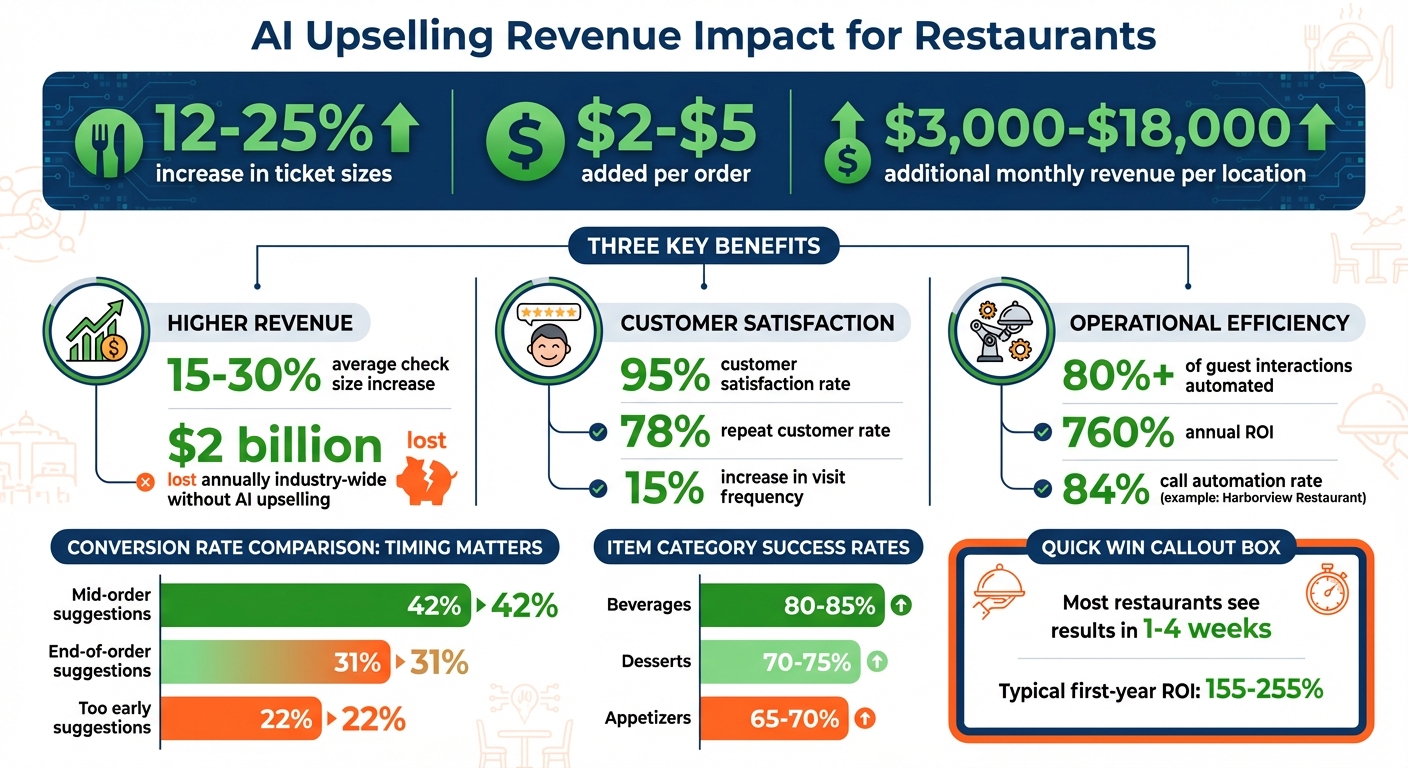
AI Upselling Revenue Impact for Restaurants: Key Statistics and Benefits
AI upselling uses customer data to deliver personalized, real-time suggestions. Whether you're on a phone call, browsing online, or using a mobile app, these systems make recommendations that feel natural, not forced.
AI taps into customer history to understand preferences and predict future choices. By analyzing past orders, it identifies patterns and tailors suggestions. For example, the system might recognize you by your phone number or account login and suggest your "usual" items or new dishes that align with your tastes.
It doesn’t stop there. Contextual factors like the time of day, weather, or local events are also considered. Picture this: you order a spicy curry, and the system recommends a cooling lassi or iced tea to balance the heat.
When it detects larger orders, such as multiple entrees, the AI shifts its focus. Instead of individual items, it might suggest shared platters or premium add-ons. For instance, sides might be highlighted for orders over $15, while upgrades are suggested for totals above $25. Integration with POS systems ensures these recommendations are inventory-aware and prioritize high-margin items.
This real-time analysis allows the system to adapt dynamically, offering suggestions that feel timely and relevant.
Armed with detailed customer profiles, AI uses real-time cues to make complementary suggestions during the ordering process. Thanks to natural language processing (NLP), it can pick up on accents, slang, or dietary preferences, ensuring its timing and tone feel conversational.
Timing is everything. Suggestions made immediately after the main selection see a conversion rate of 42%, compared to 31% when offered at the end of the order process. The way these suggestions are phrased also matters. Instead of generic prompts like "Want fries?", the AI opts for benefit-driven language, such as "That pasta pairs beautifully with our garlic bread" or "Perfect for sharing." This approach doubles conversion rates - 35% compared to just 15% for direct questions.
To avoid overwhelming customers, the system keeps suggestions concise - under 15 words - and limits prompts to 18–25% of orders. This balance helps optimize the customer experience while driving revenue.
AI upselling offers clear financial benefits while also making restaurant operations smoother and more efficient.
Restaurants using AI-driven upselling see average check sizes grow by 15–30%, translating to an extra $2–$5 per order. The results are impressive: some locations report up to $18,000 in additional monthly revenue per site. By focusing on high-margin items and timing suggestions effectively, conversion rates improve dramatically. For instance, mid-order upsell suggestions convert at 42%, compared to just 22% when made too early.
AI also ensures consistent upselling by applying its logic to every single order. It prioritizes high-margin items like beverages (80–85%), desserts (70–75%), and appetizers (65–70%) to maximize revenue while keeping the customer experience enjoyable.
AI upselling doesn’t just boost sales - it also enhances how guests perceive their dining experience. Personalized recommendations, such as pairing garlic bread with pasta or suggesting a cooling lassi with a spicy curry, feel thoughtful rather than intrusive. Data shows that 95% of customers are satisfied with automated systems, and pairing suggestions contribute to a 78% repeat customer rate.
Even during busy hours, AI remains efficient and polite. For example, AI texting upsells have been shown to increase visit frequency by 15%.
"Like many restaurants today, we're working with leaner teams who are juggling more than ever - while guests still expect the same level of attention and hospitality. That's why we need smarter tools that help us stay connected and efficient, without compromising on the quality of service."
– Michelle Mah, Slanted Door Group
AI takes over more than 80% of guest communications, allowing staff to focus on food preparation and face-to-face interactions. For example, Harborview Restaurant and Bar achieved an 84% call automation rate, while Burma Food Group saw a 141% increase in over-the-phone bookings after adopting AI.
AI operates tirelessly, handling multiple calls at once and eliminating the chance of busy signals. The financial benefits are clear: voice AI delivers a 760% annual ROI by reducing labor costs, which typically average $45,724 per year for dedicated phone staff. By seamlessly integrating with POS and reservation systems, AI provides a scalable solution that improves service quality while cutting costs.
Start by analyzing your menu to identify items with the greatest potential. Break your offerings into these categories: "Stars" (high profit, high popularity), "Plowhorses" (low profit, high popularity), "Puzzles" (high profit, low popularity), and "Dogs" (low profit, low popularity). This analysis helps Bytes AI focus on promoting your Stars while turning Plowhorses into more profitable options.
Set clear benchmarks for success. For example, calculate your current average ticket size and aim for a 12%–25% increase within 90 days. If your average order is $30, that means targeting a range of $33.60–$37.50. Establish specific goals, like increasing appetizer sales by 8%–15% or boosting dessert orders by 5%–12%. You can also set minimum order thresholds (e.g., $15) to ensure upsell suggestions are well-timed. A realistic goal is for AI-driven upselling to contribute about 5% of your total revenue.
Once your goals are in place, you’re ready to integrate Bytes AI into your operations.
Bytes AI integrates seamlessly with popular POS systems like Clover, Square, Toast, and NCR. Once connected, it automatically syncs your menu, pricing, and hours of operation. Bytes AI offers two main plans:
Most restaurants can go live within 24–48 hours after an initial test call and fine-tuning. The system is designed to remember customer preferences, including past orders, favorite items, and dietary restrictions, to make smarter, personalized suggestions.
"Since we added Bytes, every call gets picked up immediately. It even suggests add-ons automatically, so our ticket averages have gone up without us pushing anything." – Adel A., Aramex Restaurant
Set up specific IF/THEN rules to guide the AI’s recommendations. For instance, if a customer orders pasta, the AI might suggest garlic bread or a house salad. You can also program time-based rules, such as recommending drinks and desserts during lunch or premium entrées and appetizers at dinner.
Take advantage of party size intelligence. For orders involving four or more guests, the AI can suggest family-style portions or multiple appetizers. You can also create dynamic bundles: small sides priced at $2–$4 for orders under $15, and premium add-ons between $6–$12 for orders over $25. Keep suggestions short - under 15 words - since this format achieves a 41% conversion rate compared to 29% for longer prompts. Limit the AI to two upsell attempts per interaction to avoid overwhelming customers.
Regularly reviewing these rules ensures they stay relevant as trends and customer preferences evolve.
Once your upselling rules are in place, use the Bytes AI dashboard to track performance. This tool provides real-time insights into revenue, order volume, and upsell success rates. The ideal frequency for upselling is 18%–25% of orders, balancing higher revenue with guest satisfaction, which typically averages around 4.6 out of 5.
Analyze which items perform best and adjust your upselling rules to reflect seasonal trends or menu changes. For example, Taha A. from House of Wings reported that in just one month, Bytes AI handled 300 calls, converted over 150 into orders, and brought in more than $5,000 in revenue. Also, pay attention to the timing of upsell suggestions. Mid-order upselling achieves a 42% conversion rate, compared to just 22% when suggestions are made too early.
When using Bytes AI, it’s essential to track metrics that directly tie to revenue growth. These measurements help you understand performance and fine-tune your upselling strategy for better results. Let’s dive into the three key indicators.
AOV is a straightforward way to assess how much customers are spending per order. To calculate it, divide total revenue by the number of orders. Compare your baseline AOV (from the 30 days before introducing Bytes AI) to your current numbers. Use this formula: (New AOV - Previous AOV) / Previous AOV.
For example, if your AOV increases from $20 to $23, that’s a 15% growth: ($23 - $20) / $20. Many restaurants see their AOV rise between 12% and 25% within the first 90 days of adopting Bytes AI. To keep track of trends and adjust your upselling strategies, monitor this metric weekly.
Next, examine how often customers respond positively to upsell suggestions.
This metric measures how effective your AI-driven upsell suggestions are. Calculate it by dividing the number of successful upsells by the total number of upsell attempts, then multiply by 100. A strong success rate usually falls between 25% and 35%.
To dig deeper, break down this rate by factors like time of day, party size, or menu category. For instance, larger groups (four or more) tend to accept family-style upgrades more often, with success rates ranging from 35% to 50%. If your success rate drops below 25%, it might be time to revisit the timing or frequency of your suggestions.
Finally, assess the overall financial impact of Bytes AI.
ROI evaluates whether the revenue generated by Bytes AI justifies its cost. Use this formula: (Additional Revenue - AI Cost) / AI Cost × 100. Be sure to include both direct revenue increases and any labor cost savings in your calculation. Many restaurants report a first-year ROI between 155% and 255%.
Regularly tracking ROI ensures that Bytes AI continues to deliver measurable value. If the numbers start to dip, it may be time to tweak your approach or revisit your goals.
AI upselling addresses a major challenge in the restaurant industry - an estimated $2 billion is lost each year due to missed opportunities in suggestive selling. By consistently recommending add-ons, AI ensures no potential revenue slips through the cracks, even during the busiest hours.
Restaurants that implement AI upselling typically see ticket increases ranging from 12% to 25%, with some locations earning an extra $3,000 to $18,000 per month. This steady revenue boost comes alongside a more streamlined, automated ordering process. On top of that, AI reduces the workload for staff by automating over 80% of guest interactions, cutting down the need for extensive upselling training.
With Bytes AI, implementation is straightforward. Its seamless POS integration and easy-to-use dashboard allow you to set up rules in minutes - like pairing a house salad with pasta orders. The system uses your historical data to pinpoint high-margin pairings and perfect timing for suggestions, demonstrating how automation can bridge the revenue gap.
Most restaurants notice tangible improvements within 1 to 4 weeks of rolling out the system.
"Like many restaurants today, we're working with leaner teams who are juggling more than ever - while guests still expect the same level of attention and hospitality. That's why we need smarter tools that help us stay connected and efficient, without compromising on the quality of service." – Michelle Mah, Slanted Door Group
Start tracking your average order value (AOV) today to measure how AI-driven upselling can transform your bottom line.
When done with care, AI upselling improves the guest experience by providing timely and natural recommendations that come across as helpful, not pushy. The goal is to align with customer preferences, adding value to their experience while keeping interactions smooth and enjoyable.
AI-driven upselling can increase your average check by 12% to 25% within just 90 days. Some restaurants even report an extra $2 to $5 per order in as little as 27 days. While results depend on factors like how it's implemented and how customers respond, many businesses see noticeable gains in a short period.
AI relies on customer data - such as purchase history, online behavior, preferences, and real-time interactions - to make targeted upsell suggestions. By leveraging this information, it can create personalized recommendations that resonate with individual customers, enhancing their experience and driving more sales.