
Restaurant Technology
Published March 14, 2026
AI sentiment analysis turns restaurant reviews into precise, aspect-level insights that fix service issues, guide marketing, and boost revenue.

AI sentiment analysis helps restaurants understand customer feedback by identifying whether reviews are positive, negative, or neutral. With 93% of diners checking reviews before choosing a restaurant, this technology turns overwhelming feedback into actionable insights. Tools like Bytes AI analyze reviews across platforms, break them down into categories like food, service, and ambiance, and highlight trends to improve operations and marketing. Advanced models, such as those using BERT, can even detect nuances like sarcasm, achieving up to 88% accuracy.
Key takeaways:
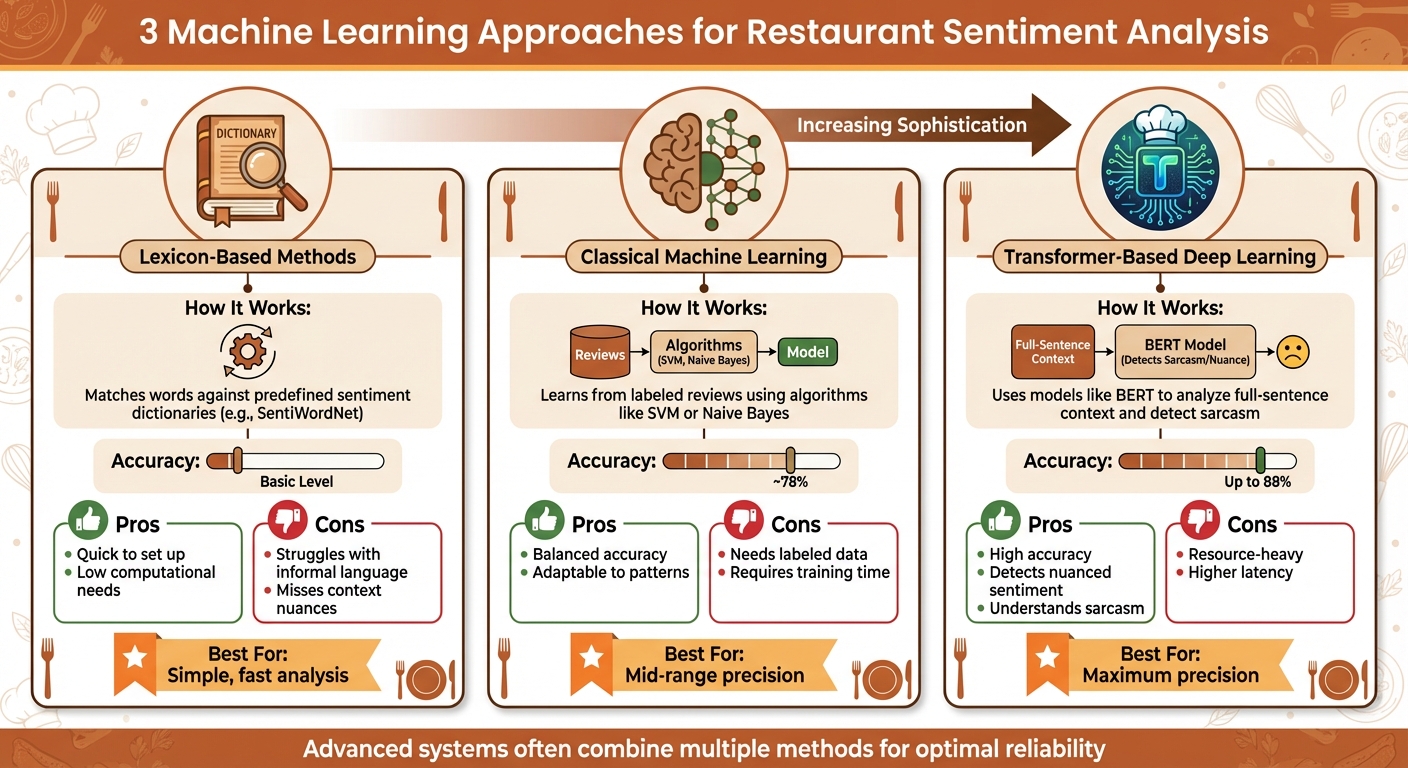
Comparison of AI Sentiment Analysis Methods for Restaurant Reviews
AI sentiment analysis transforms raw restaurant reviews into insightful data that uncovers how customers genuinely feel. It all begins with data collection - gathering feedback from sources like Google, Yelp, social media, and even POS terminals to capture a wide range of customer opinions. Afterward, the system processes this data through several advanced steps, turning unstructured text into meaningful insights. This sets the stage for sentiment classification.
Through natural language processing (NLP), AI categorizes reviews as positive, negative, or neutral. It doesn’t just count words like "good" or "bad"; instead, it evaluates both tone and intensity. For instance, "The pasta was okay" is interpreted differently from "The pasta was absolutely incredible!" Each review gets a polarity (positive, negative, or neutral) and a strength score.
Context plays a huge role. As FeedbackRobot puts it:
Context is key – 'light' can praise ambiance or flag low energy.
Take the phrase "not bad" - it shifts from a negative to a mildly positive sentiment because of a single word. While simpler methods often achieve around 70% accuracy, more advanced systems can handle these subtleties with greater precision.
Before the system can analyze reviews, it first cleans and standardizes the text. This preprocessing stage is crucial, as it directly impacts the model's ability to differentiate between a happy diner and an unhappy one. The process includes converting text to lowercase, breaking it into individual words (tokenization), and removing filler words like "the" or "is" that don’t convey sentiment.
However, negation words must stay intact. Words like "not", "never", or "don’t" are essential for understanding the true meaning of a review. For example, "not bad" would incorrectly become "bad" if these words were removed. Advanced systems even translate emojis into descriptive text to capture the emotions diners express through symbols. Finally, the text undergoes POS-aware lemmatization, reducing words to their base forms - for instance, "running", "ran", and "runs" all become "run" - to ensure more accurate sentiment analysis.
Once the text is cleaned, machine learning models can step in to provide precise insights. Here are three main approaches, each with its own strengths and weaknesses:
| Method | How It Works | Pros | Cons |
|---|---|---|---|
| Lexicon-Based | Matches words against predefined sentiment dictionaries | Quick to set up, low computational needs | Struggles with informal language and context |
| Classical Machine Learning | Learns from labeled reviews using algorithms like SVM or Naive Bayes | Balanced accuracy and adaptability | Needs labeled data and training time |
| Transformer-Based Deep Learning | Uses models like BERT to analyze full-sentence context and detect sarcasm | High accuracy and nuanced understanding | Resource-heavy with higher latency |
When it comes to understanding customer feedback, overall sentiment scores only tell part of the story. Sure, they give a general idea of how diners feel, but they miss the details - like glowing praise for the pasta alongside complaints about slow service. That’s where Aspect-Based Sentiment Analysis (ABSA) comes in. ABSA breaks reviews into specific categories - like food, service, ambiance, and price - and analyzes the sentiment for each one separately.
This detailed approach shows you exactly what’s working and what needs attention. For example, diners might rave about your food but dislike the ambiance. With ABSA, you’re not guessing; you know precisely where to focus your efforts.
ABSA identifies specific terms in reviews - like "pasta" or "service" - and assigns a sentiment score to each. This process involves a mix of techniques tailored for restaurant feedback:
Modern systems often combine these approaches. For instance, Large Language Models (like ChatGPT) handle the initial task of identifying relevant aspects, while smaller, localized models handle sentiment scoring. This hybrid setup ensures accuracy while keeping computational costs manageable.
Domain-specific training is also crucial. Models learn that phrases like "the restaurant was dead" refer to low attendance, not poor quality. Similarly, "spicy" might be a compliment in a Thai restaurant but a complaint in a different context. These nuanced insights help restaurants make better operational decisions and refine their marketing strategies.
Sentiment scores range from -1 (extremely negative) to +1 (extremely positive), with a "compound score" summarizing the sentiment. Each aspect gets its own score, highlighting what drives satisfaction and what detracts from it.
Let’s look at an example. In a study of 1,000 reviews for Bouchon Bakery, ambiance scored the highest with a compound score of 0.808, while service lagged behind at 0.778. Food was mentioned 756 times - far more than price, which only appeared 262 times - showing what mattered most to customers.
| Aspect | Common Keywords | Positive Example | Negative Example |
|---|---|---|---|
| Food | taste, flavor, fresh | "The pasta was exceptional." | "The bread was stale." |
| Service | staff, waiter, speed | "Fast and friendly service." | "Our server took forever." |
| Ambiance | decor, music, atmosphere | "Very cool looking inside." | "The place was too loud." |
| Price | cost, value, expensive | "Great value for the money." | "Overpriced and empty." |
These scores also reveal sentiment composition - the balance of positive, neutral, and negative language within each aspect. Interestingly, most restaurant reviews tend to be about 70% neutral, making it even more important to focus on the remaining positive or negative sentiments.
Context is everything. A "loud atmosphere" might be a plus for a sports bar but a drawback for a fine dining restaurant. Advanced systems take the type of restaurant into account, ensuring the sentiment analysis aligns with customer expectations. With this level of precision, restaurants can fine-tune their services and marketing to better meet customer needs.
Collecting sentiment data from customer reviews is just the first step. The real game-changer is using these insights to shape your marketing strategies and improve customer satisfaction. Sentiment analysis isn’t just about understanding customer opinions - it’s about turning that understanding into action.
Think of sentiment analysis as your digital pulse-check on customer feedback. It helps you uncover patterns before they snowball into bigger issues. For example, AI tools can highlight recurring complaints, like slow service on weekends, or consistent praise for a particular menu item.
The trick is to dig into the specifics. If your sentiment data shows that long wait times are a common issue on Friday and Saturday nights, you’ve got a clear direction. Maybe it’s time to adjust staffing, introduce a digital waitlist, or rethink your seating arrangements.
Sentiment analysis also opens the door to competitive insights. By monitoring feedback about nearby businesses, you can spot gaps in the market. For instance, if other restaurants are getting negative reviews for limited vegetarian options, you can step in and promote your plant-based menu. This turns customer feedback into a strategic advantage, helping you stand out in a crowded market.
By identifying these trends, you can create campaigns that directly address what your customers want.
Sentiment data provides a roadmap for campaigns that hit the mark. If reviews constantly rave about your signature pasta dish, it’s a no-brainer to feature it in your social media ads or email campaigns. If customers love your cozy ambiance, showcase it with stunning interior photos in your promotions. This ensures your marketing aligns with what customers already love.
You can take it a step further with personalization. By integrating sentiment analysis with your CRM system, you can tailor follow-ups to individual preferences. For example, mention a guest’s favorite seasonal dish or reference their anniversary celebration in your communications. This kind of personal touch builds loyalty, and even a small increase in customer retention - just 5% - can boost profits by 25% to 95%.
Sentiment analysis also helps you respond quickly to negative feedback. Automated alerts let you act in real time - whether it’s offering a free dessert, a discount code, or a heartfelt apology. This kind of swift action can turn a dissatisfied customer into a loyal one. As Bill Gates famously said:
Your most unhappy customers are your greatest source of learning.
Bytes AI takes sentiment analysis a step further by seamlessly integrating it into your daily operations. By connecting with popular POS systems like Clover, Square, Toast, and NCR, it uses real-time data to deliver insights that help refine marketing strategies and improve customer experiences.
Bytes AI's unified review intelligence, known as Radar, pulls reviews from platforms like Yelp, Google Reviews, and social media into a single dashboard. Using advanced NLP engines, it transforms raw text into sentiment scores almost instantly, allowing you to identify emotional trends in real time.
The platform’s AI Summaries and Insights Dashboard turn customer feedback into clear trends and performance metrics. For instance, if reviews frequently mention slow service on Tuesday evenings, Bytes AI will alert you to the issue immediately, instead of weeks later. It also tracks financial metrics, like revenue generated from AI-powered upselling, average order values, and delivery fee savings when customers order directly rather than through third-party apps.
Bytes AI’s Customer Intelligence feature goes a step further by tracking individual customer preferences, such as past orders, favorites, and allergies, to provide personalized recommendations. Feras A., a manager at Zyara, shared his experience:
Bytes handles calls better than most new hires - it's calm, consistent, and never forgets details. It even remembers repeat customers and their preferences.
This ability to combine sentiment data with personalized service helps foster customer loyalty.
To keep up with evolving customer needs, Bytes AI is expanding its capabilities to turn every customer interaction into a marketing opportunity. Soon, it will offer automated reservation booking and menu inquiries handling, streamlining operations even further. These new features will help manage peak-hour calls, ensuring no inquiry is left unanswered.
For example, at House of Wings, manager Taha A. reported that Bytes AI managed 300 calls over 30 days, converting over 150 into orders and generating more than $5,000 in additional revenue. It also saved approximately 58 hours of staff time for every 805 calls handled. With these upcoming tools, restaurants can capture even more interactions, turning every customer touchpoint into a chance for sentiment analysis and revenue growth.
AI sentiment analysis has reshaped how restaurants handle customer feedback, offering a practical way to address concerns in real time. Whether it’s undercooked food or slow service, identifying these issues early helps protect your reputation before they escalate.
The financial upside here is hard to ignore. A single-star boost in your restaurant’s rating can increase revenue by 5% to 9%, and businesses leveraging customer analytics outperform their peers by 85% in sales growth. Considering that 93% of diners check reviews before choosing where to eat, your online reputation plays a critical role in attracting customers.
Using aspect-based analysis, restaurants can zero in on operational strengths and weaknesses. When integrated with systems like POS and CRM, this data becomes even more powerful, offering insights into each customer’s lifetime value and visit history. This allows for personalized follow-ups, which can win back up to 38% of at-risk guests.
Bytes AI simplifies this process by acting as a centralized feedback hub. It pulls reviews from platforms like Google, Yelp, and social media into one dashboard, automating service recovery and ensuring no customer interaction goes unnoticed.
With the sentiment analytics market projected to grow from $3 billion in 2025 to $5.83 billion by 2029, adopting AI sentiment analysis now sets the stage for long-term success. It equips restaurants with the tools to enhance customer satisfaction while driving profitability through data-driven decision-making.
To kick off sentiment analysis, start by gathering customer feedback from sources like online reviews, social media mentions, and direct comments. Pay close attention to review texts, star ratings, and comments on platforms such as Yelp and Google Reviews. It's also helpful to collect specific details about aspects like service, food, ambiance, and staff, as these can pinpoint what’s working well and where there’s room to improve. Leveraging AI tools with natural language processing (NLP) can make this process more efficient, turning raw feedback into meaningful insights.
Sentiment analysis leverages advanced natural language processing (NLP) techniques to understand informal language, including slang and emojis. By training on datasets rich in casual expressions and visual cues, these systems can interpret the emotional undertones of such content. Emojis, for instance, are often linked to specific sentiments, allowing the analysis to gauge emotional tone more effectively.
Detecting sarcasm, however, is a tougher challenge. Newer AI models tackle this by examining the broader context, sentence structure, and subtle linguistic hints to discern when the literal meaning of a statement clashes with the speaker's actual intent.
Sentiment analysis can be a game-changer when it comes to understanding customer feedback. By evaluating aspect scores - like food quality, service, or ambiance - you can uncover trends in how customers feel about different parts of your business.
For instance, if food consistently gets high ratings, use that strength in your marketing. Create campaigns that showcase your top-rated dishes or highlight glowing reviews from happy diners. On the flip side, if ambiance scores are lagging, address it head-on. Maybe it's time to refresh the decor, adjust the lighting, or improve seating arrangements.
The key is tailoring your marketing strategies to align with customer sentiment. Show your audience that you're listening by emphasizing the changes you’ve made and your dedication to their satisfaction. This not only builds trust but also keeps your messaging relevant and impactful.