
Restaurant Technology
Published March 12, 2026
AI reservation systems turn empty tables into revenue by predicting demand, cutting no-shows, and optimizing seating in real time.

Running a restaurant during peak hours is chaotic - missed calls, no-shows, and overbookings cost restaurants tens of thousands of dollars annually. AI reservation systems solve these problems by managing bookings 24/7, predicting demand, and dynamically adjusting table assignments. Here’s how they help:
Restaurants like Burma Love and Flour + Water have seen revenue grow by thousands monthly using AI tools. These systems optimize table use, manage cancellations, and ensure smooth operations during peak times, saving time and money while improving the guest experience.
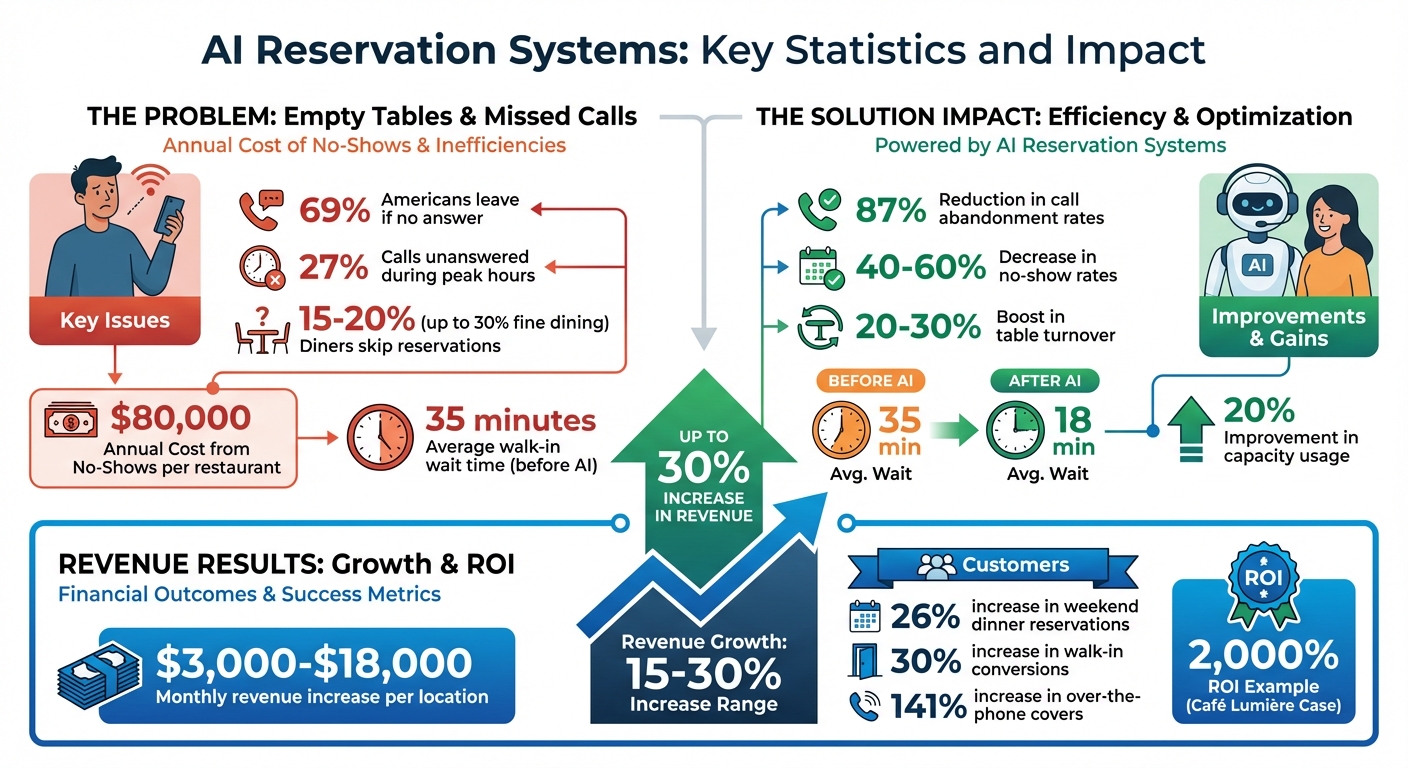
AI Reservation Systems Impact on Restaurant Revenue and Operations
Peak hours often expose the flaws in traditional reservation systems, as high call volumes and unexpected walk-ins stretch staff to their limits. This can lead to operational chaos, lost revenue, and unhappy guests.
Manual reservation systems are prone to errors like double-bookings, especially when staff are overwhelmed by phone calls, walk-ins, and managing seated guests. Imagine a party showing up to find their reserved table already taken - this forces staff to scramble for a quick fix. During peak dinner hours, up to 27% of calls go unanswered, and 69% of Americans say they’d move on to another restaurant if no one picks up the phone. In late 2025, Burma Love faced this exact issue during their busy Friday and Saturday evenings, with their host stand missing reservations due to overwhelming call volumes. Adding to the problem, no-shows further complicate seating arrangements and capacity management.
No-shows are a persistent issue, with 15% to 20% of diners skipping their reservations - and this number can climb to 30% at fine dining restaurants. During the pandemic, 28% of Americans failed to honor their bookings, and 12% admit they’re now more likely to no-show.
Each no-show represents wasted potential. For example, a party of four skipping their reservation could cost a restaurant $180 in lost revenue. Bella Vista Bistro in Portland learned this the hard way, experiencing a 34% no-show rate before taking action in late 2025. Beyond the financial loss, these empty tables also disrupt the flow of service, slowing down overall turnover.
Without real-time insights into table availability and service speed, restaurants often struggle with inefficient seating and scheduling. Tables can stay occupied longer than necessary, which reduces the number of guests served during peak hours. Flour + Water in San Francisco dealt with this problem in 2025. Before adopting AI-powered reservation tools, their average walk-in wait time stretched to 35 minutes, causing them to lose valuable customers. Missing just six parties in one evening can wipe out an entire night’s profit.
| Challenge | Operational Impact | Revenue Impact |
|---|---|---|
| No-Shows | Wasted staffing/inventory | Direct loss of cover revenue |
| Missed Calls | Chaos at the host stand | Lost booking opportunities |
| Overbooking | Poor guest experience | Negative reviews and reduced loyalty |
| Slow Turnover | Longer wait times for walk-ins | Fewer nightly covers |
AI reservation systems tackle capacity challenges by leveraging real-time data and predictive analytics to make quick decisions about seating, scheduling, and table management. Unlike older systems that depend on manual updates and fixed floor plans, AI constantly monitors key operational details - like table status and incoming reservations - and adjusts capacity as needed.
AI systems integrate data from various sources into a unified dashboard, instantly updating table availability for phone, web, and SMS bookings as soon as a guest’s check is processed at the POS.
By analyzing party sizes and past dining patterns, AI predicts table turnover times with precision. Some systems even modify floor plans dynamically - adding or removing tables based on incoming reservations - to make the best use of available space. This can lead to a 20% improvement in capacity usage and boost revenue by up to 30%.
AI also fills schedule gaps caused by early departures or cancellations by offering those slots to waitlisted guests. High-risk reservations, flagged based on booking behavior, trigger automated reconfirmation requests or deposit requirements to minimize no-shows. These measures can cut no-show rates by 40% to 60%. All of this real-time data feeds into predictive models that anticipate peak dining times.
AI uses predictive analytics to analyze historical booking trends, dining habits, and even local events to forecast demand. It identifies patterns - like regular large group bookings on Friday nights - and adjusts floor plans and staffing levels accordingly.
"AI reservation systems use complex algorithms to analyze historical data, current trends, and even factors like weather to predict customer flow." - Loman.ai
For example, Burma Love implemented an AI system between Q4 2024 and Q2 2025 to handle peak-hour call volumes. The result? An 80% drop in missed calls, a 26% rise in weekend dinner reservations, and a 141% increase in over-the-phone covers. The system pinpointed rush hours - 5 to 7 PM on Fridays and Saturdays - and automated reservation handling during those times.
AI also enables dynamic overbooking, calculating safe overbooking levels based on historical no-show data. This ensures tables stay occupied, boosting seating efficiency by 15% to 25% and preventing the loss of up to $80,000 annually from empty tables. These forecasts allow for smarter capacity adjustments, ensuring peak periods are optimized without sacrificing service quality.
In addition to tracking and forecasting, AI systems streamline the process for walk-ins and cancellations. When a cancellation comes in - via phone, text, or web - the system updates availability instantly and notifies the next waitlisted guest via SMS, managing two-way communication seamlessly.
Flour + Water in San Francisco adopted an AI platform in 2025 that offered real-time table updates and automated waitlist management. Within a month, they saw a 30% increase in walk-in conversions and a 22% drop in no-shows. Average guest wait times fell from 35 minutes to 18 minutes, adding approximately $13,680 in monthly revenue.
"Smart waitlist management can turn no-shows into opportunities." - Hostie
AI also uses predictive turnover models to estimate dining durations based on party size and historical data, allowing it to quote accurate wait times and tighten reservation schedules. This approach can boost table turnover by 15% to 30%, improving capacity management during busy hours while keeping the guest experience smooth and enjoyable.
AI reservation platforms excel at managing capacity during busy times through three key features: automated waitlist control, no-show prevention tools, and data-based table distribution. These features work with real-time tracking and forecasting to ensure empty seats are filled, revenue is protected, and service runs smoothly during peak hours.
With AI, waitlisted guests are reassigned instantly when cancellations occur, removing the need for staff to make manual calls. Notifications are sent via SMS to the next potential diner, allowing for quick, one-tap confirmations. AI also adapts table layouts dynamically as bookings come in, rather than sticking to rigid configurations. Case studies highlight that AI systems can handle up to 90% of inbound calls during peak hours, letting staff focus on in-person service while increasing phone-based bookings significantly. This automation lays the groundwork for smoother operations and better customer management.
AI minimizes no-shows by analyzing patterns in guest behavior, historical data, and time-specific trends to assess reservation risks. It assigns risk scores and uses automated reminders and reconfirmation messages to reduce no-shows. For instance, a study of 500,000 restaurant calls between Q4 2024 and Q2 2025 revealed a 27.45% reduction in no-show rates within just three months of AI implementation. Additionally, one-click cancellation options encourage guests to cancel proactively, reducing last-minute surprises. AI also employs smart overbooking, using historical data to calculate safe extra bookings to offset predicted no-shows. This strategy can prevent up to $80,000 in annual revenue losses caused by unfilled seats.
AI optimizes seating by aligning party sizes with the most efficient table setups and predicting dining durations based on past data. For example, a family-owned bistro boosted its table turnover rate by 30% in 2025 by adopting AI-powered seating strategies. Similarly, a high-end New York restaurant saw a 21% revenue increase after implementing flexible reservation times and data-driven seating adjustments. The system continuously refines seating arrangements, ensuring maximum efficiency and better use of available space.
Bytes AI builds on the success of AI in managing dynamic capacities, offering a solution tailored to tackle the chaos of peak hours. By automating reservation bookings, handling menu inquiries, and integrating seamlessly with POS systems, it ensures restaurants never miss a booking opportunity - all without increasing staff hours. Let’s explore how Bytes AI streamlines reservation management with precision and ease.
Bytes AI manages an unlimited number of calls simultaneously, guaranteeing instant responses even during the busiest times. It connects with major reservation and POS platforms like OpenTable, Square, and Toast, enabling real-time tracking of table availability and allowing for immediate bookings, changes, or cancellations. When tables are fully booked, the system automatically adds guests to a waitlist, reducing lost revenue during peak hours. Quick responses are key here - leads are nine times more likely to convert if they hear back within five minutes, safeguarding revenue during high-demand periods.
Bytes AI's integration with POS systems such as Square and Toast creates a two-way data connection. This ensures real-time updates for table availability, waitlists, and kitchen orders, eliminating the need for manual input. The system also keeps menu availability up to date for callers, preventing orders for items that are out of stock. Restaurants using AI reservation systems with built-in POS integration often see a 26% increase in covers. Beyond that, AI-enhanced POS systems have been shown to improve operational efficiency by 15% and boost customer satisfaction by 10%. Drawing on historical data from the POS, Bytes AI personalizes guest experiences by remembering returning customers’ preferences - like dietary needs or favorite tables - fostering loyalty and repeat visits.
Bytes AI is designed to be both affordable and quick to implement for small and medium-sized restaurants. The system can typically be up and running within one to three weeks, covering setup, data syncing, and staff training. Voice-based assistants further cut administrative work by 20%, freeing up staff to focus on delivering exceptional service. Considering that labor costs in the restaurant industry often make up 30–35% of revenue, this automation helps streamline staffing while ensuring no booking opportunities are missed during peak hours.
AI reservation systems are transforming restaurant operations by delivering tangible financial and operational benefits. Here’s a closer look at the measurable outcomes they offer.
One of the standout advantages of AI-powered seating systems is the ability to increase table turnover, which directly boosts revenue. Restaurants using these systems report an average 20% rise in table turnover, allowing them to serve more guests without needing additional space or staff.
Take, for instance, a 45-seat bistro in San Francisco that adopted AI-based pacing and table assignment tools in July 2025. The restaurant saw a 15% improvement in table turnover, increasing from 1.8 to 2.07 turns per night. This change added 6–8 extra parties each evening, resulting in a daily revenue boost of $1,200–$1,600. The system's ability to allocate smaller tables to couples and reserve larger tables for groups during peak hours played a key role in this success.
Additionally, the bistro elevated its Revenue Per Available Seat Hour (RevPASH) from $42.50 to $51.20 - a 20.5% increase - generating approximately $12,500 in extra monthly revenue and over $150,000 in annual sales.
By continuously tracking table availability and improving guest communication, AI systems significantly reduce wait times, which enhances the overall dining experience. For example, Flour + Water in San Francisco implemented an AI reservation system in 2025, leading to a 30% increase in walk-in conversions and raising its customer satisfaction score from 4.2 to 4.7 stars.
Similarly, Burma Love adopted an AI-powered phone handling solution that achieved a 91% customer satisfaction rate for AI interactions. This system also increased reservation bookings by 26% during weekend dinner service in October 2025. This is particularly impactful, as 69% of Americans are likely to abandon a restaurant if their call goes unanswered, and call abandonment rates can hit 27% during peak hours.
AI reservation systems also deliver impressive revenue gains by optimizing capacity usage. Many restaurants report monthly revenue increases ranging from $3,000 to $18,000 per location, often recouping their investment within the first month.
For example, Bella Vista Bistro in Portland reduced its no-show rate from 34% to just 5% by using predictive modeling and automated SMS confirmations. This change reclaimed $8,400 in monthly revenue, allowing the restaurant to break even within six weeks.
Another success story comes from Café Lumière, a 60-seat bistro in San Francisco. In July 2025, the restaurant adopted an AI reservation system to address a 40% missed call rate. Within three months, Café Lumière saw a 23% increase in monthly revenue - from $127,500 to $156,400 - resulting in a staggering 2,000% return on a $199 monthly subscription.
AI-driven table management can boost restaurant revenue by as much as 30%, while empty tables can cost a restaurant up to $80,000 annually. Even small improvements, such as reducing no-shows by 1% to achieve a 0.5% revenue increase or cutting table turnover time by 20 minutes to raise revenue by up to 7%, can lead to meaningful financial gains. These results clearly demonstrate how AI systems not only streamline operations but also drive significant growth in revenue and customer satisfaction, solidifying their place in the future of restaurant management.
Managing peak-hour chaos in restaurants doesn't have to be overwhelming. With AI-powered reservation systems, challenges like missed calls, empty tables, and guest dissatisfaction can become a thing of the past. These systems streamline bookings, optimize table assignments, and predict peak demand, ensuring smoother operations during the busiest times.
The stakes are high - every empty table is a missed revenue opportunity. On average, empty tables cost restaurants $80,000 annually. However, AI systems can increase revenue by 15%–30%, cut no-show rates by up to 60%, and reduce call abandonment by as much as 87%. This means fewer missed opportunities and more time for staff to focus on delivering exceptional service.
Bytes AI is at the forefront of this transformation. Their upcoming features, including automated reservation booking and peak-hour call handling, are designed to help restaurants of all sizes. By integrating real-time table tracking, seamless POS connectivity, and menu inquiry management, Bytes AI provides a comprehensive solution that redefines how restaurants manage capacity.
Whether you run a cozy neighborhood café or a bustling casual dining spot, investing in AI reservation systems is a smart move with quick returns. Let the technology handle the logistics, so your team can focus on crafting memorable dining experiences that keep guests coming back.
As one restaurant owner shared:
"Our no-shows dropped 60% and we book tables even when closed" - Fine Dining Restaurant Owner
AI leverages dynamic floor plans, real-time availability, and demand forecasting to streamline table assignments. It fine-tunes seating arrangements automatically, adapting to current reservations and guest preferences. This ensures the space is used to its fullest potential while maintaining efficiency.
When used effectively with predictive analytics, AI-driven overbooking can help cut down on wait times and reduce no-shows by making the most of available capacity. On the flip side, if not handled correctly, it might backfire - causing longer waits by overestimating how much space is actually available. To address this, advanced AI reservation systems are built to tackle these challenges, ensuring smoother operations and better efficiency, especially during busy periods.
Integrating AI reservation systems with your POS doesn’t have to be complicated, especially with the right support. The process largely depends on your existing POS setup. Typically, it involves checking for compatibility with APIs, webhooks, and real-time data syncing. Once you’ve confirmed these elements align, the next steps include configuring the system, running tests to ensure everything works smoothly, and training your staff on how to use it effectively.
While there are some technical aspects involved, many modern POS systems are built to simplify this kind of integration, making it a realistic option for most restaurants.