
Restaurant Technology
Published March 7, 2026
AI phone assistants, centralized order aggregation, and branded apps reduce missed calls, improve order accuracy, and boost restaurant revenue and guest satisfaction.

Restaurants are transforming how they engage with customers by using AI systems to automate tasks like answering calls, taking orders, and managing reservations. These tools handle up to 80% of calls, reduce errors, and boost efficiency, helping restaurants focus on in-person service while increasing revenue by 3–6% monthly.
Key insights:
Restaurants adopting AI see better customer satisfaction, streamlined operations, and steady growth. The future includes smarter reservations, voice-activated ordering, and predictive analytics for demand forecasting.
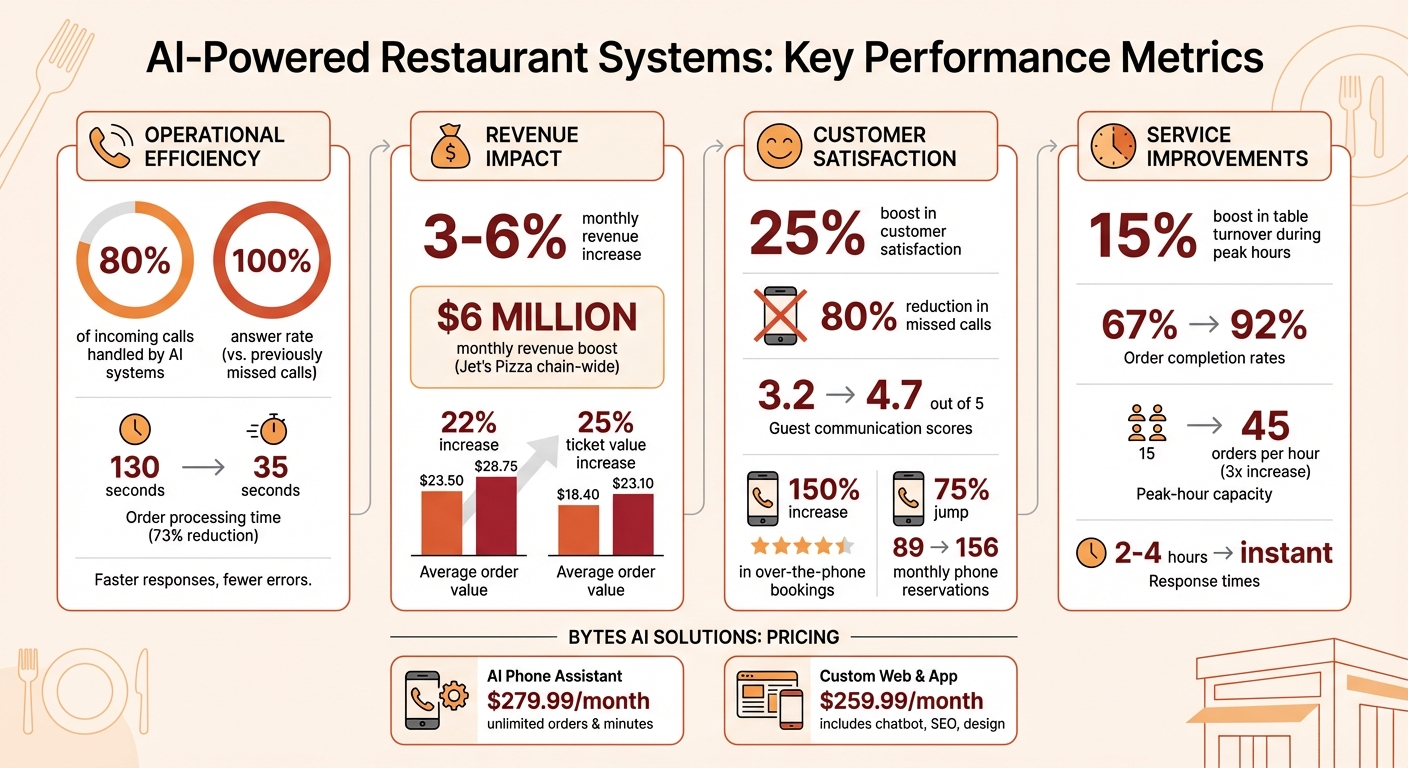
AI Restaurant Systems Impact: Revenue, Efficiency & Customer Satisfaction Statistics
AI-powered systems for restaurants bring together three key features that simplify operations and create more personalized customer experiences. These components work in harmony to build a detailed customer interaction history, enhancing service quality and efficiency.
AI phone assistants are designed to handle calls 24/7, managing tasks like answering questions, taking orders, and booking reservations. Unlike older automated systems with clunky menus, these assistants use natural language processing (NLP) to understand what customers are asking for. They can even remember preferences like dietary restrictions and suggest menu items based on a caller’s past orders. Tailored to your restaurant's menu, hours, and promotions, these systems can also switch between languages like English and Spanish to accommodate diverse customers. For more complex issues, they seamlessly transfer the call to a human staff member.
These AI voice hosts can handle up to 80% of incoming calls, freeing your staff to focus on in-person guests. For instance, Bytes AI offers a phone assistant service priced at $279.99 per month, which includes unlimited orders and minutes. This ensures predictable costs, even during busy times, while collecting valuable data to improve customer interactions.
Managing orders from multiple platforms - like DoorDash, Uber Eats, phone calls, and your own website - can get chaotic. Centralized order aggregation solves this by consolidating all orders into one system. This eliminates the need to juggle multiple devices or apps, reducing errors and missed orders. These systems integrate directly with your POS, reservation tools, and CRMs, cutting down on manual data entry and streamlining your workflow.
For example, Bytes AI combines orders from its AI phone assistants, custom apps, and major delivery platforms into a single dashboard. This unified view makes it easier to track performance, spot trends, and adjust your operations based on real-time data. During peak hours, this setup can be a lifesaver, ensuring smoother service and fewer mistakes.
Custom-branded websites and apps give you more control over the customer experience while helping you keep a larger share of revenue. These platforms come equipped with AI chatbots that handle orders, answer customer questions, and manage reservations - all while reflecting your restaurant's unique personality.
Bytes AI, for example, offers a Web & App plan at $259.99 per month, which includes features like menu management, unlimited graphic design updates, SEO optimization, and direct marketing tools. The chatbots on these platforms remember customer preferences and order history, enabling them to make personalized recommendations. For instance, if a guest frequently orders vegetarian dishes, the chatbot might highlight new plant-based specials during their next visit. This personalization can encourage higher order values.
Another perk is that these platforms are accessible 24/7, allowing customers to browse menus, place orders, or book tables even when your restaurant is closed. Companies like Sweetgreen use website chatbots to handle inquiries automatically, escalating only the more complex ones to human support.
Together, these three components create a seamless system that not only improves customer interactions but also builds a rich database of preferences and behaviors to refine future experiences.
Start by identifying where your operations face the most strain. Dive into call logs, reservation data, and POS reports to uncover issues like missed calls, no-shows, order mistakes, or recurring customer complaints. Pay attention to metrics such as average call wait times and review customer feedback for trends - like long waits or frequent order errors - that signal areas needing improvement.
Your staff is another valuable source of insight. Ask them about challenges during peak hours. Are they overwhelmed by phone orders while trying to serve guests? Do they struggle to answer questions about dietary options or daily specials? If managing orders from multiple online platforms leads to confusion, it might be time to centralize order processing. These observations will guide you in selecting AI features that directly address your restaurant's pain points.
Once you’ve identified your challenges, align them with AI tools that can make a difference. For example, platforms like Bytes AI offer a variety of solutions, such as 24/7 AI-powered phone assistants, centralized order aggregation, and custom-branded apps tailored to customer needs.
If your restaurant handles high call volumes, especially during busy hours, AI-powered phone assistants can manage orders and reservations seamlessly, even during peak times. For multi-location chains, centralized order aggregation ensures smooth and consistent operations across all sites.
If building stronger customer relationships while cutting back on third-party platform fees is a priority, consider custom-branded apps with built-in AI chatbots. These apps can provide personalized ordering options based on customer history. For diverse communities, incorporating multilingual support - like English and Spanish - can enhance the customer experience. Make sure any AI solution integrates effortlessly with your existing POS and reservation systems for a smooth transition.
It’s crucial to reassure your team that AI is there to lighten their workload, not replace them. Start with a one-hour group session to explain how the system will handle routine tasks, allowing your staff to focus on delivering excellent in-person service. Follow up with two to three days of hands-on demos so your team can practice using dashboards and learn how to escalate calls to a human when necessary.
To build confidence, dedicate a week to role-playing scenarios where staff practice AI handoffs. Afterward, let them shadow live interactions for the first month to get comfortable. Keep an eye on performance metrics like answer rates - aiming for 100% compared to previously missed calls - along with improvements in order accuracy and customer satisfaction. Track revenue per call and measure how much extra time your staff gains for face-to-face service. Use integrated dashboards to review weekly reports on call handling and customer feedback, making adjustments as needed. With 40% of restaurant operators worldwide now using AI for customer service tasks like phone inquiries, adopting these tools is becoming the norm.
When it comes to handling peak-hour chaos, Bytes AI has proven to be a game-changer for several businesses. Take Café Lumière in San Francisco, for example. Before September 2025, the restaurant struggled to manage its weekend dinner rushes, missing 40% of calls between 5:30 PM and 8:30 PM. After General Manager Sarah Chen introduced Bytes AI, missed calls plummeted to just 3%. The change didn’t just help with customer communication - it added $28,000 in monthly revenue. With staff now free to focus on table service, the restaurant saw a 15% boost in table turnover during those busy hours.
Fiery Nashville Hot Chicken faced a similar struggle, losing 450 calls every month during evening rushes. After adopting Bytes AI in 2024, missed calls dropped to just 14 per month within 27 days. Order processing times fell dramatically - from 130 seconds to just 35 seconds - tripling the speed of service. The result? A 10x return on investment in less than a month. One cashier even shared:
My Apple Watch stopped buzzing. I finally breathe between tickets.
Jet's Pizza took things a step further by rolling out Bytes AI across its entire chain. The results were staggering: monthly revenue jumped by $6 million, order completion rates soared from 67% to 92%, and peak-hour capacity tripled from 15 to 45 orders per hour.
Bytes AI also excels in improving the customer experience. Between May 2024 and July 2025, three San Francisco restaurants - Burma Love, Nisei, and China Live - deployed Bytes AI’s voice agent solution. Under the leadership of Sarah Chen at Burma Love and David Park at Nisei, these restaurants reduced missed calls by 80%, adding $12,000 in additional monthly revenue per location. Burma Love alone saw its missed call rate drop from 47% to just 9%, while Nisei’s guest communication scores jumped from 3.2 out of 5 to an impressive 4.7.
At Wayfare Tavern, Bytes AI’s virtual hostess system transformed over-the-phone bookings, increasing them by 150%. The AI handled multiple reservation requests simultaneously during peak hours, ensuring no caller was left waiting. Similarly, Sunrise Bistro introduced Bytes AI’s chatbot in just five days in 2024. The restaurant doubled its reservations and boosted revenue by 50% through better table utilization and round-the-clock automated booking. Guest response times improved dramatically, dropping from the industry average of 2–4 hours to instant replies.
Beyond managing operations and boosting satisfaction, Bytes AI has been instrumental in driving revenue growth. One of the standout features is its ability to upsell strategically. Jet's Pizza, for instance, increased its average order value by 22%, from $23.50 to $28.75, by suggesting complementary items like garlic bread with pepperoni pizza. The system also recovered 12% of abandoned calls through SMS follow-ups, resulting in a 14% higher profit margin compared to third-party delivery platforms.
Fiery Nashville Hot Chicken saw similar success. Automated prompts for spice levels and side upgrades pushed average ticket values up by 25%, from $18.40 to $23.10. Meanwhile, Burma Love recorded a 75% jump in monthly phone reservations, going from 89 to 156, thanks to Bytes AI’s efficient reservation system.
| Restaurant | Implementation Period | Key Metric Improved | Result |
|---|---|---|---|
| Café Lumière | September 2025 | Missed Calls | 40% → 3% |
| Fiery Nashville Hot Chicken | 2024 | Average Order Value | $18.40 → $23.10 (+25%) |
| Jet's Pizza | July 2025 | Monthly Revenue | +$6 million |
| Burma Love | May–July 2025 | Phone Reservations | 89 → 156 (+75%) |
These examples illustrate how Bytes AI not only solves operational problems but also actively drives revenue and enhances the overall customer experience, cementing its place in the evolution of AI-powered solutions for restaurants.
Restaurants are building on the operational improvements brought by AI and are now exploring how emerging features can transform customer interactions.
AI is reshaping how restaurants operate by introducing tools that simplify and enhance customer experiences. For instance, automated reservation systems are becoming smarter, syncing with platforms to prevent double bookings and manage availability in real time. This reduces the need for staff intervention, streamlining the process. Similarly, AI-powered menu inquiry systems can provide instant answers to questions about ingredients, allergens, or ongoing promotions, ensuring customers get accurate information without delays.
Bytes AI is leading the charge with these features, including a new POS system tailored for modern restaurant operations. Voice-activated ordering is another exciting development, allowing customers to place orders naturally, as if speaking to a person. Predictive analytics is also stepping into the spotlight, using data like past sales, weather trends, and local events to forecast demand. This helps restaurants prepare just the right amount of food, cutting down on waste. On the tech frontier, some systems are experimenting with augmented reality for virtual menu previews and IoT tools that optimize kitchen workflows in real time.
AI is proving to be a game-changer for restaurant scalability. By automating tasks like call handling, restaurants can redirect staff to focus on in-person service. Centralized order management systems minimize errors across delivery and pickup channels, ensuring smoother operations. According to RestoHost AI, clients have reported revenue boosts from capturing calls that would have otherwise gone to voicemail.
Consistency is another major benefit. AI systems deliver uniform service quality across multiple locations, even in areas facing staffing shortages. Predictive tools take this a step further by analyzing customer preferences and order history to suggest personalized menu options, creating a tailored dining experience. Automated feedback systems, which often reach out to customers a few hours after their visit, provide timely insights that help restaurants improve. These advancements are already setting the stage for even more innovation in the future.
To fully embrace the next wave of AI advancements, restaurant owners need to address current challenges like missed calls, slow order processing, and inconsistent service. Identifying these pain points is crucial for selecting AI features that integrate smoothly with existing systems and deliver quick results.
Training staff to monitor AI tools is equally important. By keeping an eye on metrics like call handling efficiency, revenue growth, and customer satisfaction, restaurants can evaluate the impact of their AI investments. As the industry moves toward features like 24/7 operations and multilingual capabilities, early adopters of technologies like voice AI and predictive analytics are positioning themselves to stay ahead of the competition.
AI-powered customer interaction systems are reshaping how restaurants in the United States operate. These systems work around the clock, streamline order management, and create more personalized experiences for diners. They address common pain points like missed calls, staffing shortages, and inconsistent service quality.
Restaurants using AI voice assistants have reported impressive results, including a 3–6% revenue increase and a 25% boost in customer satisfaction. These systems can handle up to 80% of inbound calls, making operations more efficient and interactions more responsive.
Bytes AI stands out with its integrated platform, offering solutions like AI phone assistants for $279.99/month (unlimited orders and minutes) and custom-branded websites and apps for $259.99/month. With upcoming updates, Bytes AI is positioning itself as a key player in driving long-term growth for restaurants.
Getting started is simple. Begin by identifying your most pressing challenges, such as peak-hour call overload or inaccurate orders. Choose AI features that fit seamlessly with your current systems, and train your team to track key metrics like call performance and customer feedback to fine-tune operations.
Restaurants that adopt AI today will be better equipped for the future. As voice-activated ordering, predictive analytics, and IoT integrations become the norm, early adopters will have the tools and experience to scale effortlessly. Now is the time to embrace AI and stay ahead of growing customer demands.
AI-powered customer interaction systems work best when they connect seamlessly with widely-used tools like cloud-based POS systems for managing orders and inventory, as well as reservation platforms like OpenTable, Resy, or SevenRooms. These connections simplify workflows, make reservation management smoother, and boost operational efficiency.
To keep tabs on ROI, pay attention to key metrics like missed call recovery, revenue growth, labor cost savings, and enhancements in customer experience. Dive deeper into specifics such as call volume, missed-call rates, and average order value to gauge overall performance. Consistently monitoring these figures helps you understand the financial impact and make adjustments for better results. Metrics like captured calls, fewer missed opportunities, and successful upsells give a solid snapshot of the system's advantages.
During peak times, AI systems step in to manage tasks such as handling large call volumes, processing detailed orders, and addressing questions about the menu. If a situation arises that needs human intervention, the AI quickly hands it off to the staff, keeping interactions smooth and uninterrupted. This setup lets employees concentrate on assisting in-person customers or tackling more complex issues, while the AI takes care of routine duties, boosting both workflow efficiency and customer satisfaction.