
Restaurant Technology
Published February 24, 2026
AI turns guest data into personalized campaigns, predicts churn, and boosts restaurant revenue through automated segmentation and targeted promotions.

AI is transforming how restaurants approach marketing by using data to create personalized campaigns, predict customer behavior, and optimize promotions. Instead of relying on generic ads, restaurants can now target specific customer groups, recover at-risk diners, and boost revenue with tailored offers.
Key Takeaways:
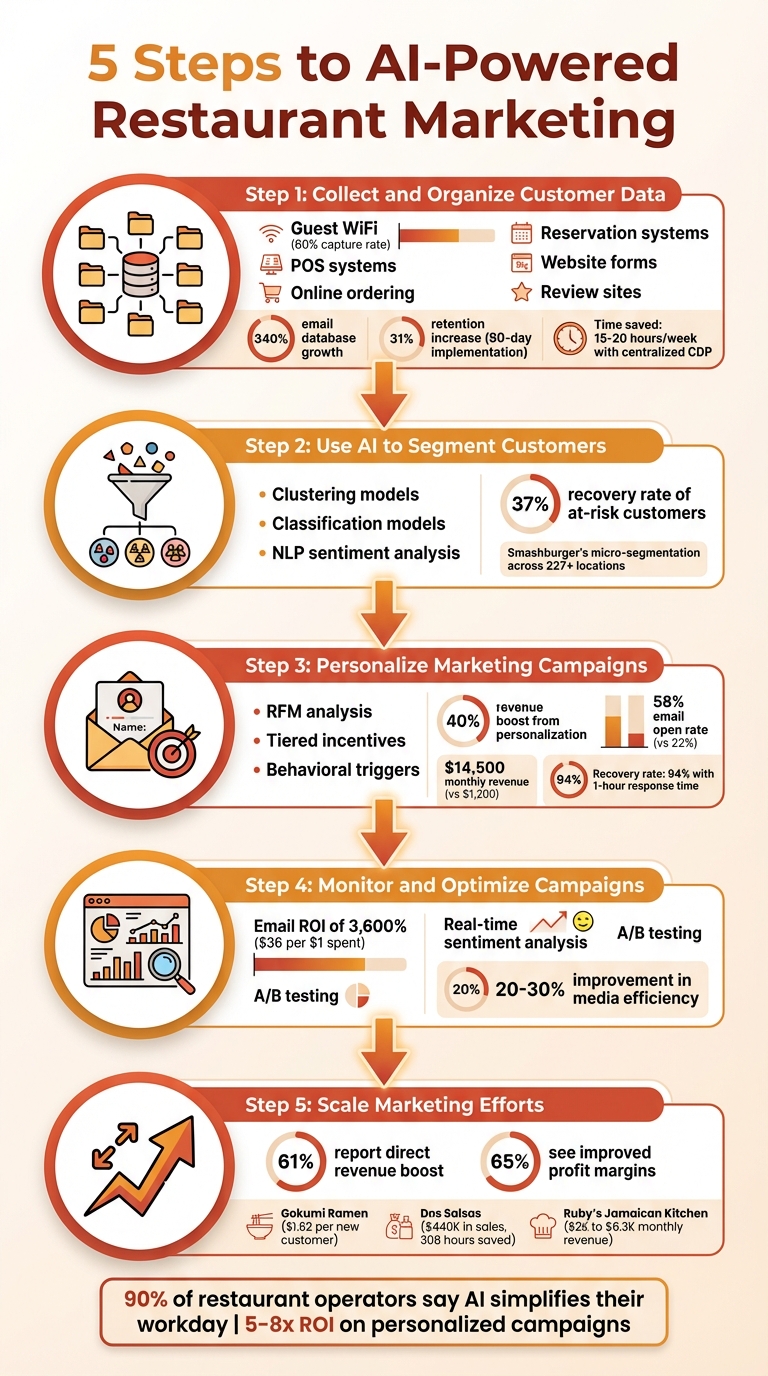
5-Step AI Restaurant Marketing Implementation Process
AI thrives on accurate and well-organized data. Every day, your restaurant generates a wealth of information from different sources. The challenge is consolidating it in one place so AI can put it to good use.
Your restaurant gathers customer data from a variety of touchpoints, including:
However, the data often ends up scattered across multiple disconnected platforms. One marketing manager highlighted how pulling information from five separate systems delayed their ability to launch timely campaigns.
Raw data isn’t enough - it needs to be cleaned and unified. As Allen Graves, an expert author at Bloom Intelligence, points out, the quality of AI insights depends entirely on the quality of the data it receives. Issues like duplicate entries, outdated records, or fragmented data can lead to flawed AI-driven conclusions.
Centralized systems can solve this problem. A Restaurant Customer Data Platform (CDP) automatically consolidates information from all your sources into detailed guest profiles. This can save marketers 15–20 hours of manual work each week. For example, Bytes AI's centralized order aggregation combines data from various ordering channels, creating a single, reliable source for AI to identify patterns and segment customers efficiently.
The results speak for themselves. Between April and July 2025, a fast-casual chain with 12 locations implemented a unified guest intelligence platform. Within 90 days, they grew their email database by 340% using WiFi integration and increased guest retention by 31%.
With your data unified, you’re ready to move on to segmenting customers in the next step.
With centralized data, AI can uncover patterns in just minutes. Machine learning sifts through signals like visit frequency, menu choices, discount preferences, and even device usage to create detailed customer segments.
AI uses several methods to group customers effectively. Clustering models identify groups of customers who behave similarly, even if they don’t share obvious demographic traits. For instance, AI might highlight a segment of diners who consistently order appetizers on weekdays and prefer lunch hours.
Classification models focus on predicting behaviors like churn or purchase likelihood, enabling precise targeting. As Robin Johnston from Bloom Intelligence puts it, today’s segmentation tracks metrics like average check size, visit frequency, and risk of attrition.
Natural Language Processing (NLP) takes it further by analyzing online reviews to spot recurring themes. This helps separate loyal fans from unhappy customers. By using sentiment analysis, brands can identify which guests might need extra attention.
The impact is clear. AI-driven churn detection paired with automated outreach has been shown to recover up to 37% of at-risk customers. Smashburger's Loyalty Manager, Lexi Ryan, shared how micro-segmentation transformed their marketing in 2024:
"Instead of just blasting guests with communications screaming about the Smash Club program, we … tailor communications to what guests enjoy. Offers are tied to core behavior so that guests get what they love."
This personalized strategy boosted order frequency across their 227+ locations. By continually refining customer segments, AI ensures every marketing message feels relevant and aligns with diners' preferences.
Bytes AI offers powerful tools for segmentation by centralizing data from phone orders, online platforms, and branded websites into a single dashboard. This consolidated view makes it easy to analyze customer behavior across all channels.
The platform’s predictive features assign likelihood scores for specific actions, such as whether a customer will make a purchase within 14 days. This means you can quickly identify who’s most likely to respond to a weekend brunch promotion or which regulars might be slipping away.
As your customer base grows, Bytes AI adapts to keep segments updated with new data. This dynamic approach ensures you’re always ready to launch hyper-personalized campaigns that resonate with your audience.
Use segmentation insights to tailor promotions to your audience. Companies that excel in one-to-one personalization see a 40% boost in revenue from marketing campaigns compared to the average.
Connect customer segments to specific campaign strategies using RFM analysis (Recency, Frequency, Monetary). This method refines your AI-driven segmentation by assigning offers based on customer behavior. For example, frequent diners might enjoy early access to new menu items, while customers who haven’t ordered in 60 days may respond better to stronger incentives.
Tiered incentives can help re-engage inactive customers. You can adjust offers depending on how long they’ve been inactive - offering a small discount for a week-long absence and a larger reward for those who haven’t visited in a month. In June 2024, Papa Johns UAE, with over 90 locations, applied this strategy by sending personalized push notifications based on past orders to customers who hadn’t ordered in 1–2 months. This resulted in a 7% increase in monthly marginal profit from direct online orders.
Behavioral triggers are another effective tool. Automate messages to reach customers at the right time, like their usual ordering window (e.g., 5:00–7:00 PM), and include visuals of their favorite past orders. In 2025, a fine-dining restaurant replaced their monthly newsletters with behavioral triggers and saw their email open rate jump from 22% to 58%. Monthly email-driven revenue skyrocketed from $1,200 to $14,500.
AI can also help address negative sentiment. If a customer leaves feedback about slow service, send a prompt, personalized apology paired with a targeted offer, like a discount, to resolve the issue. Responding to concerns within an hour can lead to a 94% guest recovery rate. Bytes AI simplifies these processes by integrating campaign execution into one platform.
Bytes AI takes personalized campaigns to the next level by allowing you to scale them efficiently. With a custom-branded website and mobile app, you can collect first-party data and deliver promotions directly, bypassing third-party platform fees.
A centralized dashboard brings together customer interactions from phone orders, online platforms, and your branded channels. This lets you launch campaigns based on real-time customer actions - whether they’ve browsed your menu, abandoned a cart, or completed their tenth order. From there, you can send tailored push notifications, emails, or in-app messages that align with each customer segment’s habits and preferences, ensuring your promotions hit the mark.
Launching a campaign is just the beginning. To ensure success, you need to actively monitor performance and make adjustments based on insights. For example, email marketing in restaurants can deliver an incredible ROI of 3,600% - that’s $36 for every $1 spent.
It’s crucial to measure metrics that link directly to revenue. Keep an eye on email open rates, click-through rates, and redemption rates for each customer segment. AI-powered Customer Data Platforms (CDPs) can help by pulling real-time data from sources like your POS system, online orders, and even WiFi logins. This gives you a complete picture of how your campaigns are performing.
WiFi marketing tools are particularly useful for tracking foot traffic. They can show when customers visit your restaurant after seeing a digital promotion. Additionally, real-time sentiment analysis, powered by Natural Language Processing (NLP), scans online reviews on platforms like Google, Yelp, and Facebook. This helps you quickly identify service issues and understand how your marketing efforts are impacting customer satisfaction.
Tools like Bytes AI bring all these data points together in one centralized dashboard. With it, you can see which promotions are driving orders, which customer segments are responding best, and how your campaigns are influencing the profitability of specific menu items. This kind of immediate feedback allows you to address issues early and focus on strategies that are delivering results.
By analyzing these insights, you can fine-tune your campaigns for even better outcomes.
The data you collect enables you to make precise, impactful adjustments. For example, A/B testing allows you to tweak one element - like a subject line, discount offer, or image - and compare results. This approach often leads to a 20–30% improvement in media efficiency and a boost in ROI.
AI can also help you automate strategies for retaining at-risk customers. For instance, you can set up triggers to send "we miss you" offers when a guest’s visit frequency drops. These automated campaigns have been shown to bring back up to 37% of at-risk or "churning" customers.
To keep your insights accurate, it’s essential to maintain clean data. Regular data cleaning ensures reliable forecasting and better campaign performance. When your data is accurate, your marketing spend is optimized, and your campaigns are more effective.
Once your campaigns are optimized, the next step is to scale them without driving up costs. AI makes it possible for restaurants to expand their marketing reach while maintaining the same budget and labor force. In fact, in 2024, 61% of restaurant operators reported that AI implementation directly boosted their revenue, and 65% noticed improved profit margins. By automating repetitive tasks, AI frees up your team to focus on delivering exceptional hospitality. This approach also lays the groundwork for tracking ROI with precision.
Understanding your return on investment (ROI) is essential for scaling effectively. Modern AI platforms offer detailed performance tracking, even down to individual menu items. This means you can identify which promotions generate the most orders and which customer segments respond best. Take Gokumi Ramen in Santa Ana, for example. In 2025, they used AI-powered smart bidding to target high-value lookalike audiences, bringing in 600+ new guests monthly at just $1.62 per customer. This level of accuracy ensures every marketing dollar is maximized.
AI also helps capture revenue that might otherwise be lost. Consider Dos Salsas, a three-location restaurant group in Texas. By adopting AI phone answering in 2024, they handled 41,000 calls, saved 308 staff hours, and generated $440,000 in online sales. On top of that, they booked over 5,800 reservations by automatically texting links to callers. Brendan Sweeney, CEO and Co-founder of Popmenu, highlights the importance of this technology:
"AI makes sure restaurants don't lose revenue opportunities - and in a market where you have to fight for every guest, it's a good ally to have in your corner".
With detailed ROI metrics in place, Bytes AI tools can help your restaurant grow efficiently and effectively.
Bytes AI provides a suite of tools designed to scale your marketing efforts seamlessly. For instance, their AI Phone Assistants manage unlimited calls and orders 24/7, ensuring no booking opportunities are missed - even during peak hours. For $279.99/month, these assistants answer every call, promote daily specials, and instantly text reservation or ordering links to customers, helping you recover lost revenue. Upcoming features include automated reservation booking and menu inquiry handling, which will further reduce the workload on your staff.
Bytes AI also offers custom-branded websites and apps (starting at $259.99/month) to streamline customer interactions, from the first point of contact to order completion. The results speak for themselves. For example, Ruby's Jamaican Kitchen implemented AI-driven marketing automation in February 2024. Within months, their monthly marketing revenue soared from $2,000 to $6,300, eventually doubling from there. Owner Bridgett Richardson’s story shows how AI tools can amplify marketing results without increasing staff.
Eric Peterson, VP of Operations and Partner at Fado Pubs, Inc., sums it up well:
"The restaurant sales pie is getting smaller. We all need to take a bigger bite. If you're not using tech and data and analytics to drive and re-engineer your business, you're already at a disadvantage".
AI is delivering tangible benefits for restaurants today. By automating tasks like customer segmentation, tailoring promotions, and tracking performance in real time, it helps restaurant owners boost engagement, streamline operations, and increase revenue - all without adding extra labor. Consider this: 90% of restaurant operators say AI simplifies their workday and their staff’s, while 61% report direct revenue growth and 65% see better profit margins.
This shift is redefining the competitive playing field. Restaurants that hesitate to embrace AI risk falling behind as others use it to attract more customers and grow their market share.
Bytes AI makes it easy to dive in. Their AI Phone Assistants ($279.99/month) ensure no call or booking is missed, and their custom-branded websites and apps ($259.99/month) provide smooth customer experiences from the first interaction to checkout. Upcoming features like automated reservation booking and menu inquiry handling will further reduce manual tasks, allowing your team to focus on delivering exceptional hospitality. These tools are designed to turn every customer interaction into revenue.
From segmentation to revenue tracking, Bytes AI supports every part of this transformation. The results speak for themselves: restaurants using AI-powered marketing tools enjoy higher retention rates, improved ROI, and greater customer loyalty. Whether it’s recovering at-risk customers, personalizing promotions, or scaling campaigns efficiently, AI brings the precision and automation needed to thrive in today’s competitive market.
Every step of the process - from gathering data to crafting personalized promotions - uses AI to sharpen your marketing strategy. Start small with impactful changes, like automated guest recovery or targeted email campaigns, and expand as you see success.
Don’t wait to adopt AI. Every missed call or generic promotion could mean lost revenue. With tools like Bytes AI, you can make every marketing effort count and build a loyal customer base that keeps coming back for more.
To kick off using AI in restaurant marketing, start by gathering precise guest data from both your online and offline channels. This should include essential information like customer contact details, purchase history, online activity, and feedback. By integrating this data with your POS systems and other tools, you can centralize these insights, making it easier to create targeted customer segments and tailor promotions. Pay close attention to transaction records, individual preferences, and engagement metrics to craft detailed customer profiles that drive more personalized marketing efforts.
AI can identify guests who might stop visiting by spotting patterns in their behavior - like visiting less often, spending less money, or showing little to no recent engagement. With this information, restaurants can act quickly and specifically to keep these guests coming back.
To go beyond just tracking opens and clicks when measuring AI marketing ROI, it's crucial to consider broader frameworks like incrementality testing, operational savings, and revenue impact. For example, using a holdout group allows you to compare lifetime value (LTV) and determine the actual incremental gains driven by AI efforts.
Additionally, tracking metrics like the Marketing Efficiency Ratio (MER) - calculated as total revenue divided by AI-related spend - can offer deeper insights. Don’t forget to factor in operational savings, such as reduced overhead or labor costs, to paint a more comprehensive picture of ROI.