
Restaurant Technology
Published March 3, 2026
Real-time AI pricing turns static menus into revenue tools that cut waste and boost profits while keeping customers satisfied.

AI dynamic pricing is changing how restaurants manage online menus. Instead of fixed prices, it uses machine learning to adjust prices in real-time based on factors like demand, ingredient costs, weather, and local events. This method helps businesses increase profitability, reduce food waste, and improve customer satisfaction by offering timely discounts or price adjustments.
Key takeaways:
Restaurants using AI pricing have reported profit increases of 6–10%. Tools like Bytes AI make implementation straightforward, offering integrations with POS systems and delivery platforms. By starting with small tests and tracking results, restaurants can make smarter pricing decisions while maintaining customer trust.
AI dynamic pricing offers clear advantages in boosting revenue, improving efficiency, and enhancing customer satisfaction through real-time menu adjustments.
AI-driven pricing helps maximize revenue by adjusting prices based on current demand. For example, during busy hours, prices might increase by 10%–20%, while slower times could see similar discounts to encourage sales. This strategy helps convert casual browsers into paying customers.
This approach is especially important for restaurants facing margin pressure from delivery platform fees (often 20%–30%) and rising labor costs. In 2024, for instance, the minimum wage in California hit $20 per hour, making every pricing decision critical. AI identifies the ideal price for each menu item, ensuring profitability is protected. Even small tweaks - like a 5% price adjustment on popular dishes - can significantly impact overall profit margins.
AI also integrates with inventory systems to reduce food waste. By lowering prices on items nearing expiration, restaurants can turn potential losses into revenue while maintaining quality standards. These optimizations not only boost revenue but also reduce pricing errors and free up management’s time for other tasks.
Traditional manual pricing often depends on intuition or fixed markups, which fail to account for fluctuations in demand, costs, or competitor pricing. Static pricing models can leave restaurants lagging behind, as managers might take weeks to review data and update menus. By then, key opportunities are often missed.
AI eliminates these inefficiencies. It prevents underpricing during high-demand periods (which leaves money on the table) and avoids overpricing during slow times (which can drive customers away). The system automatically updates prices across POS systems and delivery apps, removing the risk of human error. By analyzing factors like sales trends, weather conditions, and local events, AI ensures pricing decisions are always informed. This not only improves profitability but also saves time, allowing managers to focus on other priorities.
AI dynamic pricing isn’t just about revenue - it also improves how customers interact with a business. By offering automatic discounts during off-peak hours and tailoring deals based on order history, AI enhances the overall dining experience. For instance, a loyal customer might receive a discount on their favorite burger during a typically quiet Tuesday afternoon.
Clear communication is key. When restaurants label price adjustments as "Off-Peak Discount" or "Rainy Day Special", customers are more likely to view the changes as fair and thoughtful rather than arbitrary. Additionally, AI can analyze online reviews and social media using Natural Language Processing to align prices with the value customers associate with specific dishes. This creates a win-win: customers enjoy better deals, and restaurants maintain a steady flow of orders throughout the day, making their menus more appealing and customer-focused.
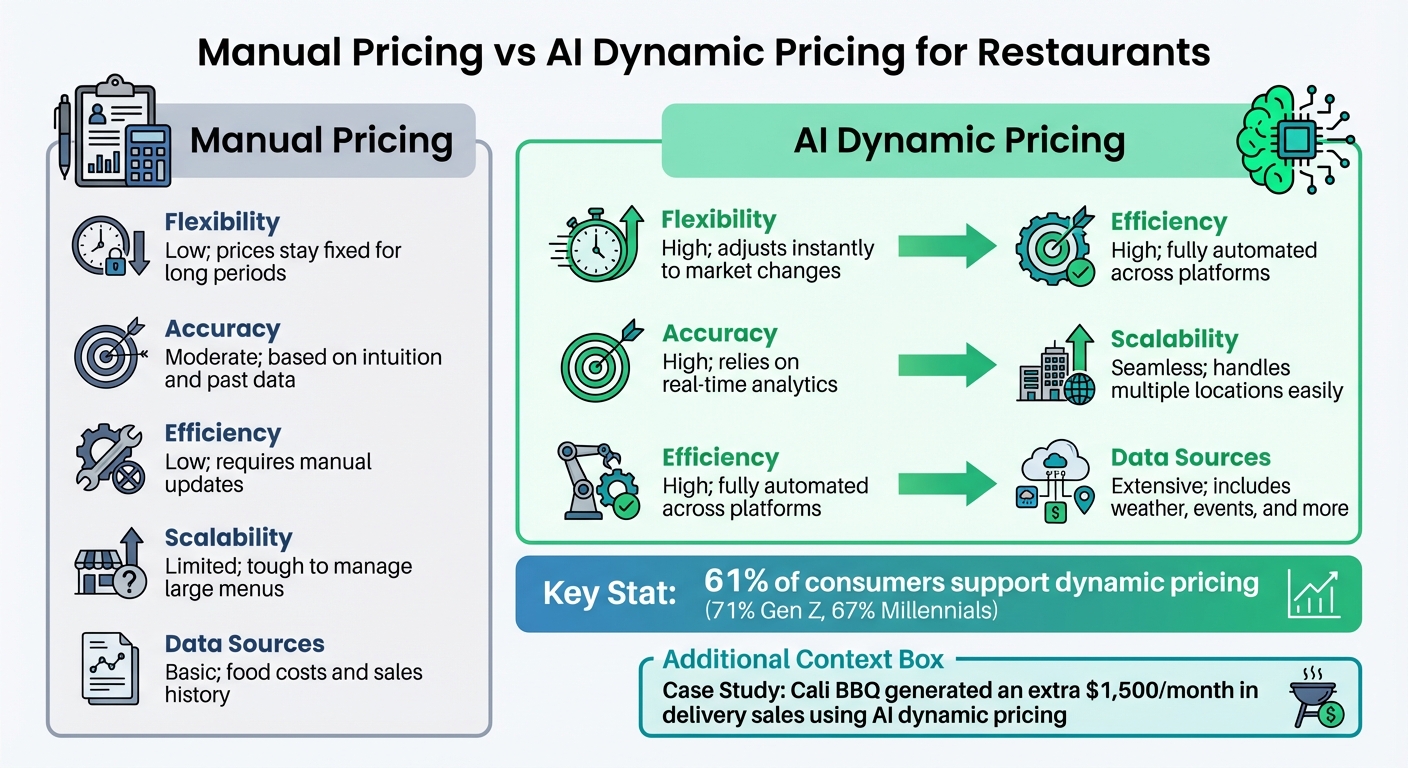
Manual Pricing vs AI Dynamic Pricing Comparison for Restaurants
Manual pricing sticks to a straightforward but rigid formula: restaurant managers set prices based on food costs and a fixed markup, often leaving these prices unchanged for months. While this approach is simple, it lacks the adaptability needed to respond to fluctuating market conditions. This sets the stage for understanding how AI dynamic pricing offers a more advanced solution for managing online menus.
AI dynamic pricing, on the other hand, uses machine learning to analyze a wide range of variables - such as demand trends, weather, local events, and real-time inventory. These algorithms automatically adjust prices across all digital channels, from your website to third-party delivery platforms, without requiring manual updates. This level of automation ensures prices remain competitive and optimized for current market conditions.
Managing hundreds of menu items manually across multiple platforms is time-consuming and prone to errors. AI software eliminates this challenge by making data-driven pricing decisions in real time. For instance, Cali BBQ in San Diego experimented with dynamic pricing for their pulled pork sandwich in 2024. By allowing the price to fluctuate with demand, they generated an extra $1,500 in monthly delivery sales - a significant boost for a small business. This example highlights the operational advantages of AI dynamic pricing over traditional methods.
Consumers are also warming up to the idea. A survey found that 61% of consumers support dynamic pricing, with even higher approval rates among younger generations - 71% of Gen Z and 67% of Millennials. As Shawn Walchef, owner of Cali BBQ, explained:
"If somebody is willing to come in at a time where we're not busy, why would I not want to incentivize them to come in earlier? It makes perfect sense".
Here’s a quick comparison of the two approaches:
| Feature | Manual Pricing | AI Dynamic Pricing |
|---|---|---|
| Flexibility | Low; prices stay fixed for long periods | High; adjusts instantly to market changes |
| Accuracy | Moderate; based on intuition and past data | High; relies on real-time analytics |
| Efficiency | Low; requires manual updates | High; fully automated across platforms |
| Scalability | Limited; tough to manage large menus | Seamless; handles multiple locations easily |
| Data Sources | Basic; food costs and sales history | Extensive; includes weather, events, and more |
This side-by-side comparison underscores why AI-driven pricing strategies are becoming the go-to solution for modern restaurants.
Setting up AI dynamic pricing involves a step-by-step approach that balances automation with careful oversight. This method ensures your system adapts to market changes while safeguarding your profit margins.
Before diving into AI pricing, start by auditing your data sources. Pull together information from your POS system, inventory management, CRM tools, and even external sources like weather APIs, event calendars, and holiday schedules. These data points help identify demand patterns.
Don’t overlook third-party delivery platforms - they provide insights into real-time demand and the impact of delivery commissions. Supply chain data is just as important; tracking ingredient costs and expiration dates allows the AI to adjust prices intelligently, protecting your margins and minimizing food waste. This comprehensive data collection lays the groundwork for accurate, market-responsive pricing.
Once your data is in order, the next step is choosing the right platform to leverage it.
Platforms like Bytes AI offer robust solutions, such as their Web & App plan for $259.99/month and AI Phone Assistants for $279.99/month. These systems integrate with most POS setups, enabling real-time data analysis. The best platforms go beyond basic demand tracking - they also consider factors like ingredient costs, competitor pricing, weather trends, and local events.
Look for platforms that allow manual overrides. While AI is powerful, your local knowledge can catch nuances the algorithm might miss. Once your platform is set up, it’s time to define your pricing strategy and test its effectiveness.
Set clear minimum and maximum price limits for each menu item to safeguard your profit margins while staying competitive. Define discount boundaries to avoid devaluing your brand. Your pricing rules should account for variables like ingredient costs, competitor prices, demand shifts, seasonality, and local events.
Start with A/B testing during less busy times to minimize risk. Test small price adjustments to gauge customer reactions before fully automating the system. This phase ensures your dynamic pricing adapts effectively to real-world market conditions. Deborah Findling, Executive Managing Editor at Square, highlights the importance of this approach:
"Dynamic pricing allows you to adjust your prices in real-time... so that you can respond to changing cost of goods sold, customer demand, and more".
Make incremental adjustments rather than drastic changes to avoid alienating customers.
Keep an eye on key metrics like revenue, profit margins, and customer feedback. Use Natural Language Processing (NLP) tools to analyze online reviews and social media for customer sentiment about your pricing changes. Regular updates are essential - refresh your AI models every three months to ensure they reflect the latest sales data and market trends.
Transparency is also key. Label price drops as "off-peak discounts" to build trust and improve how customers perceive your pricing strategy. A 2024 survey revealed that 30% of restaurateurs plan to invest in flexible or dynamic menu pricing, indicating that this approach is gaining traction across the industry.
AI technologies play a crucial role in analyzing data and making real-time pricing adjustments. They transform raw information into actionable strategies, helping optimize online menus and boost revenue.
Machine learning models dive into a variety of data points - like POS data and delivery trends - to forecast customer orders effectively. For example, LSTM neural networks excel at capturing long-term patterns, achieving a Mean Absolute Percentage Error of 6.3%, compared to ARIMA's 12.4%. These algorithms continuously improve by learning from customer responses to different price changes.
External factors like weather and time also come into play. Weather APIs and temporal data, such as holidays and weekends, are integrated into these models. For instance, regression analysis reveals that a 10°F temperature rise correlates with increased demand for cold beverages. This level of detail allows restaurants to fine-tune their pricing, leading to revenue boosts of up to 18.5% during peak hours.
Time series analysis builds on these predictions, offering even more precise seasonal pricing adjustments.
Time series models are adept at spotting hourly variations and seasonal trends, helping businesses pinpoint the best price points during peak times. Starbucks, for instance, uses this method to analyze millions of transactions, determining when to roll out happy hour deals or adjust prices for seasonal drinks.
This technology combines seasonal insights with real-time factors like local events and weather. Wendy's plans to test AI-driven dynamic pricing in 2025, using digital menu boards to make instant updates. By adjusting prices dynamically, restaurants can manage demand better - raising prices during busy hours or offering discounts like "Late-Night Cravings" during slower periods. This strategy not only boosts inventory turnover but also helps prevent kitchen bottlenecks.
Once these predictive and seasonal adjustments are in place, connecting them to online ordering platforms ensures seamless execution.
APIs serve as the bridge between AI engines, POS systems, and platforms like Uber Eats and DoorDash, enabling instant price updates. This synchronization ensures consistent pricing across all channels, while still allowing manual overrides to account for local insights the algorithm might overlook.
One mid-sized burger chain saw impressive results with this approach, reporting an 8% rise in daily revenue and a 15% drop in food waste within just two months. Platforms like Bytes AI's Web & App plan integrate seamlessly with most POS systems, making real-time pricing optimization across digital channels both practical and effective.
AI-powered dynamic pricing transforms how restaurants manage their menus, turning it into a real-time strategy that adapts swiftly to changing market conditions. By analyzing factors like ingredient costs, customer demand, and competitor pricing, restaurants can boost revenue during peak periods while offering strategic discounts during slower times to keep traffic steady. This approach doesn't just improve earnings - it also simplifies operations and minimizes waste.
These systems go a step further by reducing food waste, encouraging the sale of dishes that use ingredients nearing expiration, and cutting down on manual pricing errors. However, success hinges on having reliable data from your POS system and maintaining open communication with customers. Start small by A/B testing slight price changes, keep human oversight to ensure pricing aligns with your brand, and communicate clearly - using terms like "off-peak discounts" can help build customer trust.
For restaurants looking to take full advantage of these tools, platforms like Bytes AI's Web & App plan integrate seamlessly with POS systems, enabling real-time pricing adjustments across custom-branded websites and mobile apps. Early adopters who embrace this technology gain a competitive advantage, operating with a speed and precision that traditional methods simply can't match. This data-driven pricing strategy positions restaurants to thrive in today’s fast-paced digital world.
Customer reactions to dynamic pricing often depend on how it's perceived. If price changes seem random or aren't well-explained, people might see them as unfair. On the other hand, when businesses clearly communicate the reasons - like shifts in demand or external influences - customers are more likely to accept the changes. Highlighting perks, such as discounts during off-peak times, can also help. Ultimately, openness and good communication are essential for building trust and ensuring customers see the pricing system as reasonable.
To establish safe minimum and maximum prices in AI-driven dynamic pricing, start by analyzing key data points such as ingredient costs, demand patterns, and customer behavior. Your minimum price should always cover costs to ensure profitability, while the maximum price should reflect what customers are willing to pay, aligned with market trends. Feed these thresholds into the AI system, and make it a habit to review and adjust them regularly. This approach helps you stay responsive to market shifts while balancing profitability and fair pricing.
To make dynamic pricing work, you’ll need a variety of data points, including historical sales, customer behavior patterns, market trends, competitor pricing, menu item costs, inventory levels, and even real-time sales data. Processing all this information requires a solid data infrastructure combined with advanced analytics tools. With these in place, AI can fine-tune pricing by factoring in demand, ingredient costs, customer preferences, and changing market conditions. This approach helps improve both revenue and the overall performance of your menu.